Until the ambulance arrives
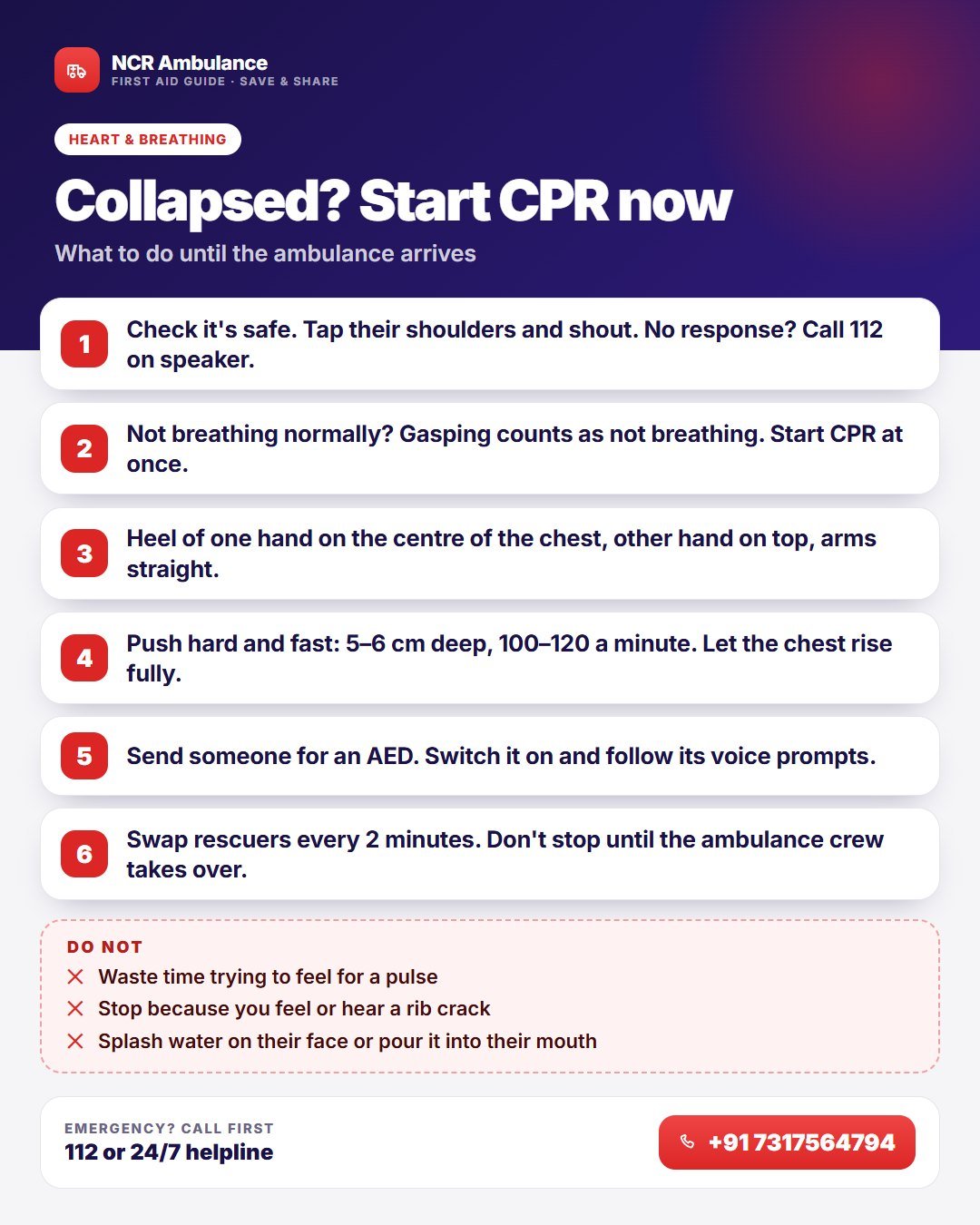
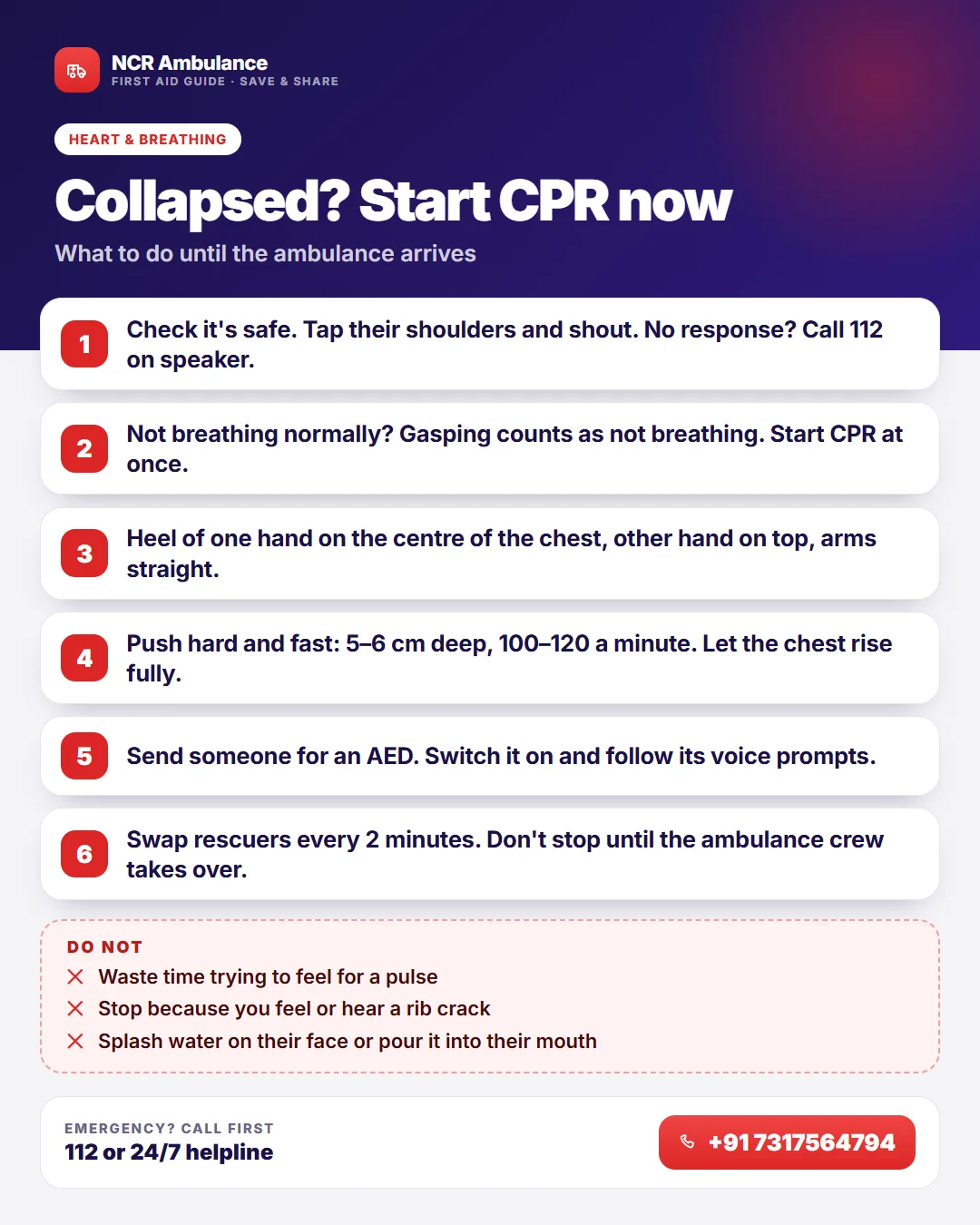
Collapsed? Start CPR now
- Check it's safe. Tap their shoulders and shout. No response? Call 112 on speaker.
- Not breathing normally? Gasping counts as not breathing. Start CPR at once.
- Heel of one hand on the centre of the chest, other hand on top, arms straight.
- Push hard and fast: 5–6 cm deep, 100–120 a minute. Let the chest rise fully.
- Send someone for an AED. Switch it on and follow its voice prompts.
- Swap rescuers every 2 minutes. Don't stop until the ambulance crew takes over.
Do not
- Waste time trying to feel for a pulse
- Stop because you feel or hear a rib crack
- Splash water on their face or pour it into their mouth
In this guide
- When should you start CPR?
- How to do CPR on an adult: step by step
- Do you need to give mouth-to-mouth breaths?
- How long should you continue CPR?
- What if you break a rib?
- Can you be blamed if CPR doesn't work?
- CPR in real situations: women, cars, lifts and crowds
- If they start breathing again
- Adult CPR: quick do's and don'ts
- Why every second of CPR counts
It happens in seconds. A man slumps over his desk in an office tower, an uncle collapses while dancing at a wedding, or a father falls in the living room after dinner. He doesn't answer when you call his name, and his breathing has turned into strange, noisy gasps. His heart has most likely stopped, and the people around him are his lifeline until help arrives.
CPR (cardiopulmonary resuscitation) is the skill that bridges that gap. It keeps blood moving to the brain until a defibrillator and an ALS ambulance with cardiac monitoring reach the patient. This guide walks you through adult CPR step by step: when to start, where to put your hands, how hard and fast to push, whether you need to give breaths, and when you can stop. You don't need a certificate. You need to start.
When should you start CPR?
Start CPR on an adult who is unresponsive and not breathing normally. That is all you need to check.
- Unresponsive: tap both shoulders firmly and shout, "Can you hear me?" There is no eye opening, no words and no movement.
- Not breathing normally: look at the chest and face for no more than 10 seconds. There is no breathing at all, or only slow gasps, snorts, gurgles or snoring sounds.
Don't try to feel for a pulse. It is easy to get wrong when you are frightened, and it wastes time the brain doesn't have. If you are unsure, start CPR. Chest compressions rarely cause serious harm to someone whose heart is still beating, but waiting when the heart has stopped is often fatal.
In the first minutes after the heart stops, many people make slow, deep gasps or gurgling sounds. Families often take this as a sign of life and wait. It is not normal breathing. It is a sign of cardiac arrest, and it means you should start CPR now. A few seconds of jerking of the arms and legs at the moment of collapse can also look like a fit. If the person then stays unresponsive and isn't breathing normally, start CPR.
A cardiac arrest is not a heart attack. In a heart attack the person is usually awake, with chest pain. In a cardiac arrest the heart stops pumping and they collapse. One can lead to the other, so if someone is awake with chest pain, follow our guide to heart attack first aid before the ambulance arrives.
How to do CPR on an adult: step by step
Step 1: Make sure it's safe to help
Take two seconds to look around before you rush in. On a road, watch for traffic. If the person may have had an electric shock, switch off the mains before you touch them. You can't help anyone if you become a second patient.
Step 2: Check for a response and shout for help
Kneel beside them, tap both shoulders firmly and shout their name or "Are you all right?" If there is no response, shout loudly for help: family members, neighbours, the society guard, anyone nearby. One extra pair of hands can make the call, fetch a defibrillator and take over CPR when you tire.
Step 3: Call 112 or an ambulance on speaker
Dial 112 or a 24/7 ambulance helpline and put the phone on speaker next to you, so both hands stay free. Say clearly: "Adult collapsed, not breathing normally, I'm starting CPR," then give the full address with a landmark. Ask for an ambulance with a defibrillator. The dispatcher can count with you and coach you through each step.
If others are present, one person calls while you start. Another fetches an AED (automated external defibrillator): offices, malls, airports, gyms and some housing societies keep one near reception or the security desk. A third waits at the gate to guide the ambulance in.
Step 4: Lay them flat on a firm surface
Roll the person onto their back on the floor. A bed or sofa sinks under your hands and absorbs much of each push, so if they collapsed on a bed, two people should slide them onto the floor. Kneel beside their chest. You can push through a thin shirt or kurta, so don't waste time undressing them, but pull aside a thick sweater or jacket if it gets in the way.
Step 5: Put your hands in the centre of the chest
Place the heel of one hand in the centre of the chest, on the lower half of the breastbone (roughly in line with the nipples). Put your other hand on top and interlock your fingers, keeping them lifted off the ribs. Straighten and lock your elbows, and bring your shoulders directly above your hands. This lets you push with your body weight rather than your arm muscles, which tire quickly.
Step 6: Push hard and fast
- Depth: push down 5 to 6 cm (about two inches) with each compression. It feels harder than you expect. That is normal.
- Speed: 100 to 120 pushes a minute, a little faster than two pushes every second.
- Recoil: let the chest rise all the way back up after each push. Don't lean your weight on it between pushes, because the heart refills during the recoil.
- No pauses: keep any breaks shorter than 10 seconds. Blood flow drops the moment you stop.
Count out loud, "one, two, three..." up to 30, then start again. Some people push to the beat of the song "Stayin' Alive", or set a free metronome app to about 110 beats a minute. Most people get tired within two minutes and their pushes get shallower without them noticing, which is why swapping helps.
Step 7: Use the AED the moment it arrives
Switch it on and follow its voice prompts. Keep pushing while another person bares the chest and sticks on the pads. Stop only when the machine says it is analysing or tells everyone to stand clear. After a shock, or if no shock is advised, go straight back to compressions. Our guide on how to use an AED defibrillator explains every prompt in plain language.
Step 8: Keep going and swap every 2 minutes
If there is anyone else around, take turns about every two minutes, or whenever the AED pauses to check the heart. Switch over in a few seconds: the new person kneels on the other side, ready to start the moment you lift your hands. Even someone who has never done CPR can take over after watching you for a minute.
Do you need to give mouth-to-mouth breaths?
For an adult who suddenly collapses, hands-only CPR is the recommended approach for untrained bystanders. In the first few minutes after the heart stops, the blood still carries oxygen, and continuous chest compressions move it to the brain. If you haven't been trained, or don't feel comfortable giving breaths to a stranger, do hands-only CPR. It is far better than doing nothing.
If you are trained and willing, you can give 30 compressions followed by 2 rescue breaths:
- Tilt the head back with one hand on the forehead and lift the chin with two fingers of the other.
- Pinch the soft part of the nose closed and seal your mouth over theirs.
- Blow steadily for about one second, just enough to see the chest rise.
- Give a second breath, then go straight back to 30 compressions. The two breaths should take less than 10 seconds.
If the breaths don't go in, don't keep retrying. Return to compressions. Breaths matter much more when the collapse started with a breathing problem, such as drowning, choking or smoke, and in children and babies. Read our guide to CPR on a child or baby to see how the technique changes for little ones.
How long should you continue CPR?
Don't stop to check whether the person has recovered. Keep going until:
- the ambulance crew arrives and takes over,
- the person shows clear signs of life: they open their eyes, move on purpose, cough or start breathing normally,
- the AED tells you to pause while it analyses or delivers a shock,
- you are too exhausted to continue and nobody can take over, or
- the place becomes unsafe for you.
In Delhi NCR, traffic, narrow lanes and high-rise buildings can all add minutes before the crew reaches the patient. Your CPR buys the brain that time.
What if you break a rib?
You may feel or hear a crack under your hands, especially in older people. This is a known side effect of effective CPR and not a reason to stop. Quickly check that your hands are still in the centre of the breastbone and not drifting onto the ribs, then carry on at the same depth. A broken rib heals. A brain left without blood flow for several minutes may never recover.
Can you be blamed if CPR doesn't work?
The fear of police cases or blame stops many people in India from helping. Remember the reality: a person in cardiac arrest will die without help, and CPR can only improve their chances.
Indian law protects people who act in good faith to help someone in an emergency, and nobody expects a bystander to perform like a doctor. Trying, and following the dispatcher's instructions, is exactly what is asked of you. Our guide to the Good Samaritan law in India explains your rights as a helper.
CPR in real situations: women, cars, lifts and crowds
- If the person is a woman: don't hesitate. The technique is exactly the same, and you can push through her clothes. The chest only needs to be bare for AED pads, so ask others to hold up a dupatta, shawl or bedsheet around her for privacy.
- In a car or auto: CPR doesn't work in a seat. Stop safely, get the person out and flat on the ground, then start.
- In a lift, staircase or narrow corridor: drag them onto the nearest flat floor where you can kneel beside the chest.
- In a crowd: point at people and give clear tasks: "You, call 112. You, ask security for the AED. You, keep people back."
If they start breathing again
If the person starts breathing normally but stays unconscious, roll them into the recovery position: on their side, top leg bent at the knee, head tilted back slightly so the airway stays open and any vomit can drain out. Our guide to first aid for an unconscious person shows how to do it safely.
Keep watching their breathing, and leave any AED pads on with the machine switched on. If they stop breathing normally again, roll them onto their back and restart CPR immediately. Tell the ambulance crew when the person collapsed, how long CPR was given and whether the AED gave any shocks.
Adult CPR: quick do's and don'ts
Do
- Call 112 or an ambulance and put the phone on speaker
- Start CPR if they are unresponsive and only gasping
- Push hard and fast in the centre of the chest
- Send someone for an AED and use it as soon as it arrives
- Swap helpers every two minutes and keep going
Don't
- Wait to see if they "come round" on their own
- Splash water, rub their hands and feet or make them sit up
- Pour water, juice or glucose water into their mouth
- Do CPR on a soft bed if you can move them to the floor
- Stop because of a cracked rib or the fear of blame
Why every second of CPR counts
When the heart stops, brain cells begin to be damaged within minutes, and every minute without CPR lowers the chance of survival. Bystander CPR keeps some blood flowing until the defibrillator and the ambulance crew arrive. Most cardiac arrests happen at home, so the person who starts CPR is usually a family member.
Save our number today: +91 7317564794. Our 24/7 emergency ambulance service in Delhi NCR works with partner crews across the region, including ambulance service in Delhi and emergency ambulance in Gurgaon. If someone collapses, call 112 or our emergency ambulance helpline, and start pushing.
Save it. Share it.
Keep this step-by-step card on your phone
Emergencies rarely give you time to search. Save this card or share it in your family and society WhatsApp groups. One person who knows what to do can save a life.
Frequently asked questions
Can I do CPR without giving mouth-to-mouth?
Yes. For an adult who suddenly collapses, hands-only CPR (continuous chest compressions without breaths) is recommended for untrained bystanders and anyone unwilling to give breaths. In the first minutes after the heart stops there is still oxygen in the blood, and pushing on the chest moves it to the brain. Breaths matter more for children, babies, drowning and choking, so give them in those cases if you can.
How long should I keep doing CPR?
Keep going without stopping to check until the ambulance crew takes over, the person clearly wakes up or starts breathing normally, an AED asks you to pause, the scene becomes unsafe, or you are physically too tired to continue. CPR is hard work, so swap with another helper about every two minutes. Short, quick changeovers keep the blood moving.
Can I be sued in India if CPR does not save the person?
A person in cardiac arrest will die without help, and CPR can only improve their chances. Indian law protects people who act in good faith to help someone in an emergency, and you are not expected to perform like a doctor. Doing your best and following the dispatcher's instructions is exactly what is asked of a bystander. Our Good Samaritan law guide explains your rights in detail.
Do I need to check for a pulse before starting CPR?
No. Bystanders are not expected to check for a pulse, because it is easy to get wrong under stress and it wastes precious seconds. If the person does not respond when you tap and shout, and is not breathing normally or is only gasping, assume the heart has stopped and start chest compressions immediately.
Can I do CPR on someone lying on a bed?
A soft mattress sinks under your hands and absorbs much of each push, so CPR on a bed is far less effective. If two or more people are present, slide the person onto the floor quickly, using the bedsheet to pull them if that helps. If you truly cannot move them, start CPR where they are rather than delay, and push as hard as you can.
What should I do if the person vomits during CPR?
Vomiting is common during CPR. Roll the person onto their side, facing away from you, let the vomit drain and wipe the mouth clean with a cloth or your fingers. Then roll them back onto their back and continue compressions straight away. Keep the pause as short as possible, because every second without compressions reduces blood flow to the brain.
Ambulance services for this emergency
24/7 coverage: Ambulance service in DelhiAmbulance service in GurgaonAmbulance service in NoidaAmbulance service in GhaziabadAmbulance service in FaridabadAmbulance service in Greater NoidaAmbulance service in Dwarka