Until the ambulance arrives
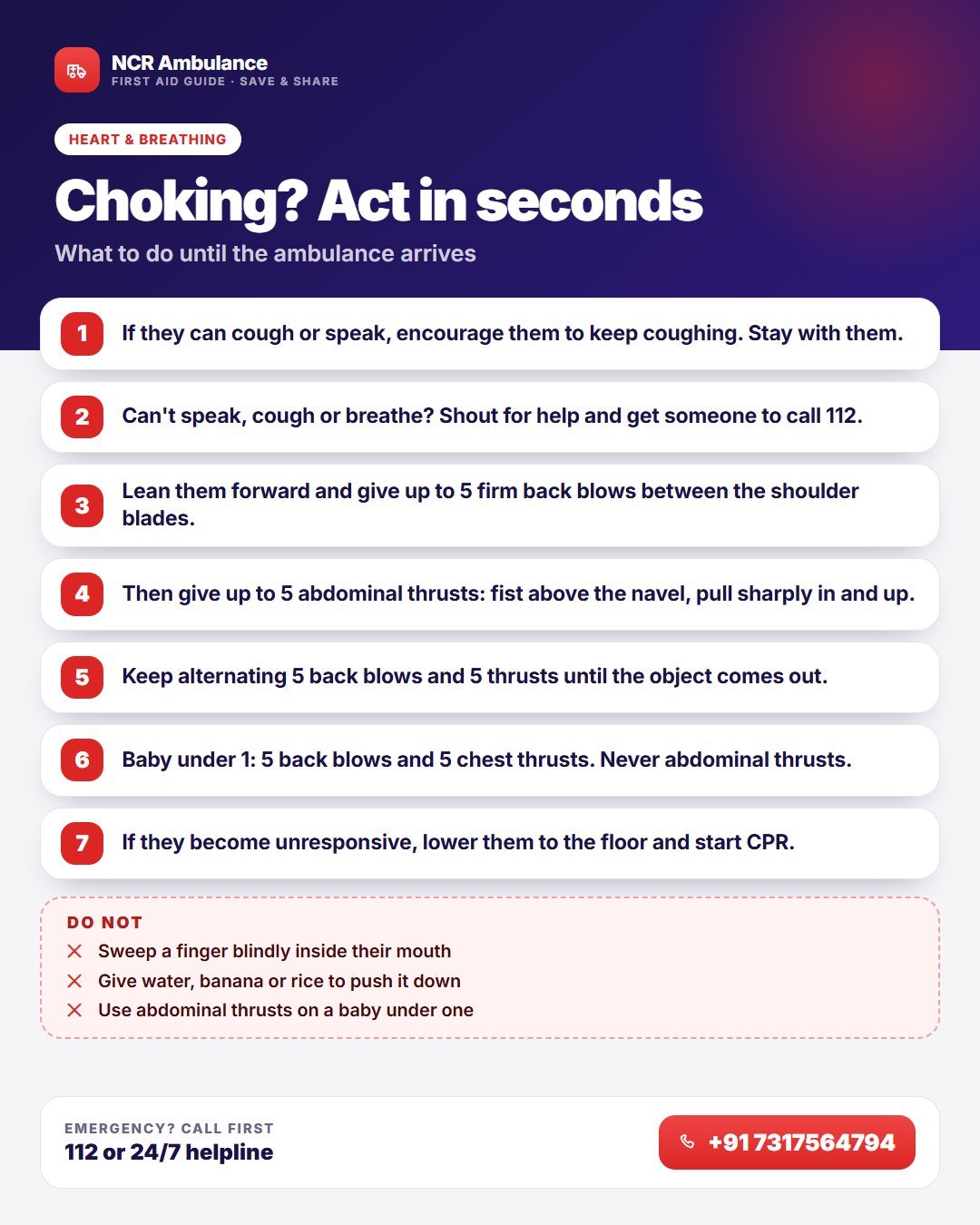
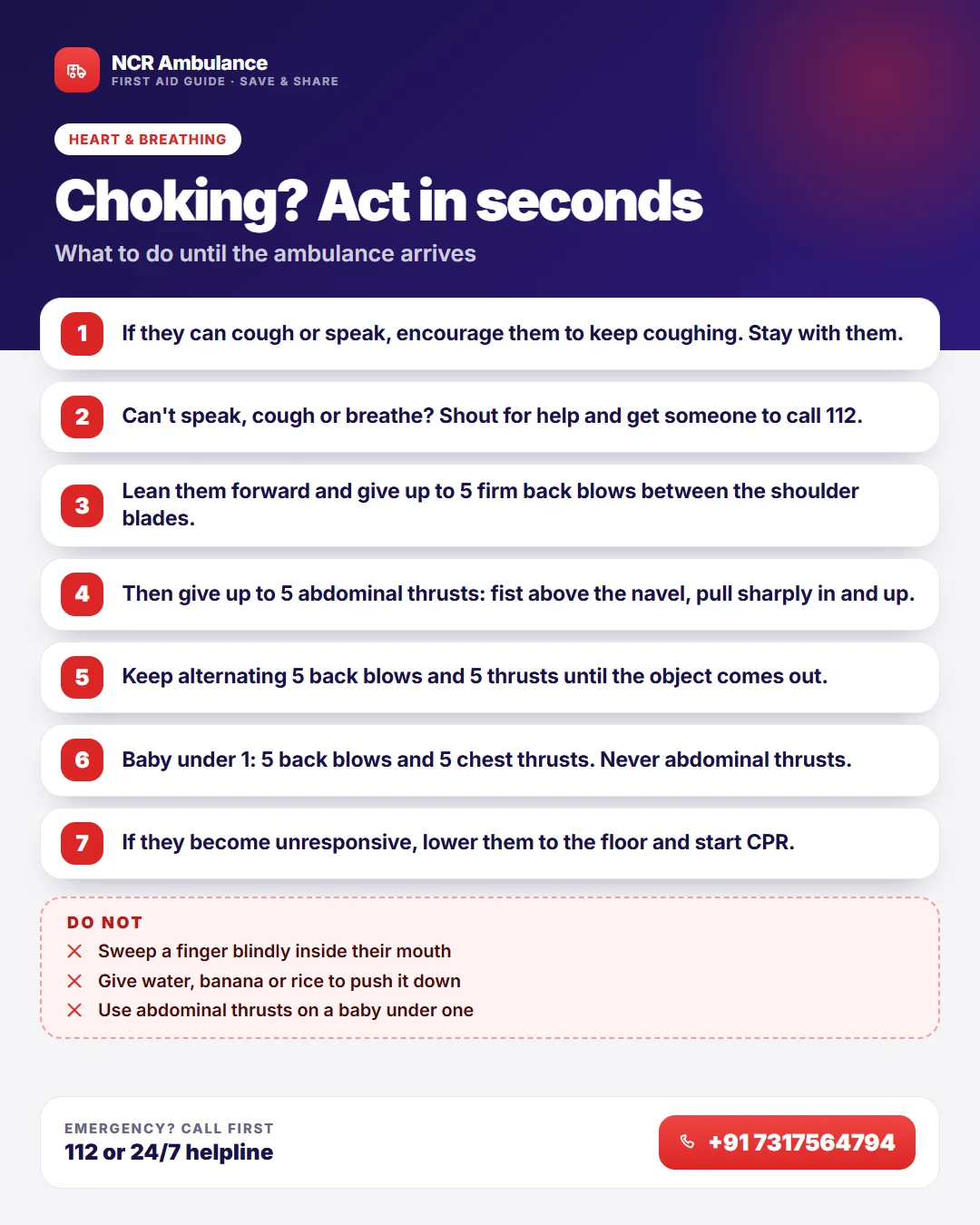
Choking? Act in seconds
- If they can cough or speak, encourage them to keep coughing. Stay with them.
- Can't speak, cough or breathe? Shout for help and get someone to call 112.
- Lean them forward and give up to 5 firm back blows between the shoulder blades.
- Then give up to 5 abdominal thrusts: fist above the navel, pull sharply in and up.
- Keep alternating 5 back blows and 5 thrusts until the object comes out.
- Baby under 1: 5 back blows and 5 chest thrusts. Never abdominal thrusts.
- If they become unresponsive, lower them to the floor and start CPR.
Do not
- Sweep a finger blindly inside their mouth
- Give water, banana or rice to push it down
- Use abdominal thrusts on a baby under one
In this guide
- How to tell mild choking from severe choking
- Mild choking: help them cough it out
- Severe choking in adults and children over 1: step by step
- Choking baby under 1 year: what to do
- What if you are alone and choking?
- What if the person becomes unresponsive?
- After the object comes out: get a medical check
- Common choking hazards in Indian homes
- Choking first aid: quick do's and don'ts
- Act fast, then call
It is a festival evening and the family is laughing around the table. Your grandfather takes a big bite of a ladoo, laughs at a joke, and suddenly goes silent. He grabs his throat, his face turns red, then dusky. Or your toddler, playing near a bowl of roasted peanuts, starts gagging and can't cry. Choking turns an ordinary moment into an emergency within seconds.
The good news is that the right first aid often clears the airway before the ambulance even arrives. This guide explains how to tell mild choking from severe choking, how to give back blows and abdominal thrusts, what to do for a baby under one year, how to help yourself if you are alone, and what to do if the person collapses. If the airway doesn't clear quickly, call 112 or our 24/7 emergency ambulance service straight away.
How to tell mild choking from severe choking
Choking happens when food or an object blocks the airway. The first thing to work out is whether the blockage is partial (mild) or complete (severe). Ask: "Are you choking?"
| Mild choking | Severe choking | |
|---|---|---|
| Speaking or crying | Can speak, answer or cry | Can't speak or cry, may just nod |
| Cough | Loud, strong cough | Weak, silent or no cough |
| Breathing | Breathing, perhaps noisily | Can't breathe, or high-pitched noise when trying |
| Colour | Normal or flushed | Lips and face turning blue or grey |
| What you do | Encourage coughing, stay with them | Back blows and thrusts, call 112 |
Mild choking: help them cough it out
A strong cough is the most effective way to clear the airway. If the person can cough, speak or breathe, encourage them to keep coughing hard. Don't slap their back while they are upright, don't give water, and don't put your fingers in their mouth. Stay with them and watch closely. If the cough becomes weak or silent, or they can no longer breathe or speak, it has become severe choking. Act immediately.
Severe choking in adults and children over 1: step by step
Step 1: Shout for help and get someone to call 112
Tell the person you are going to help. Shout for someone to call 112 or an ambulance and put the phone on speaker. If you are alone with them, start the back blows first. You can call between rounds or as soon as the object comes out.
Step 2: Give up to 5 back blows
Stand to the side and slightly behind them. Support their chest with one hand and lean them well forward, so that the object comes out of the mouth instead of going further down. With the heel of your other hand, give up to 5 sharp blows between the shoulder blades. Check after each blow whether the object has come out.
Step 3: Give up to 5 abdominal thrusts
If back blows don't work, move behind them for abdominal thrusts (the Heimlich manoeuvre):
- Stand behind the person and put your arms around their waist. Lean them forward.
- Make a fist and place it, thumb side in, just above the navel and well below the bottom of the breastbone.
- Grab your fist with your other hand.
- Pull sharply inwards and upwards, as if trying to lift them off their feet. Give up to 5 thrusts, checking after each one.
Step 4: Keep alternating until it clears
If the object still hasn't come out, repeat 5 back blows, then 5 abdominal thrusts. Keep going until the object comes out, the person can breathe and cough, or they become unresponsive.
If the person is visibly pregnant or so large that you can't reach around their stomach, give chest thrusts instead: wrap your arms under their armpits, place your fist on the lower half of the breastbone and pull sharply straight back towards you. For a child over one year, kneel behind them so you are at their height and use less force than for an adult. A small child can be laid face down across your lap for back blows.
Choking baby under 1 year: what to do
A baby's organs are delicate, so the technique is different. Never give abdominal thrusts to a baby under one year old. If the baby can cough or cry, let them cough and watch closely. If the baby can't cry, cough or breathe:
- Back blows: sit or kneel and lay the baby face down along your forearm, resting on your thigh, with the head lower than the body. Support the head by holding the jaw, keeping your fingers off the soft throat. Give up to 5 firm back blows between the shoulder blades with the heel of your hand.
- Chest thrusts: if the object hasn't come out, turn the baby face up along your other forearm, head still lower than the body. Using two fingers or the heel of one hand on the lower half of the breastbone, just below the nipple line, give up to 5 sharp chest thrusts, pressing down about a third of the depth of the chest.
- Repeat 5 back blows and 5 chest thrusts until the object comes out, the baby starts crying or coughing, or the baby becomes unresponsive. Call 112 or have someone call as soon as possible.
After any serious choking episode, a baby should be checked by a doctor. Ask the dispatcher for a neonatal ambulance for babies and newborns if the baby is very young or still struggling to breathe.
Don't hang a child upside down by the ankles and shake them, give water, banana or rice to "push it down", or put your finger down the throat to make them vomit. Blind finger sweeps can push the object deeper and block the airway completely. Remove an object only if you can clearly see it and easily pick it out.
What if you are alone and choking?
If you are choking and nobody is around, don't go into a bathroom or another room to cough in private. Go to where people can see you, or make noise to get attention: bang on a door or knock things over. Then give yourself abdominal thrusts:
- Place your fist just above your navel, grab it with your other hand and thrust sharply inwards and upwards.
- Or lean over the back of a chair, the edge of a table or a railing and press your upper stomach hard against it, again and again, until the object comes out.
Once you can breathe, call 112 or an ambulance and get checked, especially if you used a chair or table edge for the thrusts.
What if the person becomes unresponsive?
If a choking person goes limp, carefully lower them to the floor so they don't fall and hit their head. Call 112 or an ambulance if no one has yet, and start CPR immediately. Chest compressions can push the object out.
Each time you open the mouth to give rescue breaths, look inside. If you can clearly see the object, pick it out. Otherwise, keep going with CPR until the ambulance crew takes over. Follow our guide to CPR on an adult, or the separate steps for CPR on a child or baby, which give rescue breaths a bigger role.
If the person starts breathing again but is not fully awake, place them in the recovery position for an unconscious person and keep watching their breathing until help arrives.
After the object comes out: get a medical check
Even when choking ends well, the person may still need a doctor. Get them checked if:
- you gave abdominal or chest thrusts, which can bruise or injure internal organs,
- they still have a cough, wheeze, noisy breathing or chest pain,
- they find it hard or painful to swallow, or feel something is still stuck,
- a child choked on a nut or seed and later develops a cough or fever, since small pieces can slip into the lungs and cause infection days later.
A swallowed button battery or magnet is an emergency even if the child seems fine, because it can badly damage the food pipe within hours. Go to an emergency department immediately and don't make the child vomit.
Common choking hazards in Indian homes
- Food for young children: whole peanuts, roasted chana, popcorn, whole grapes, cherry tomatoes, jamun and other fruit with seeds, boiled sweets, and chunks of ladoo or barfi. Cut grapes into quarters lengthwise and avoid whole nuts for children under five.
- Small objects: coins, buttons, marbles, small toy parts, balloon pieces, bottle caps, pen caps and button batteries from remotes and toys.
- Adults and the elderly: large bites of roti or meat, eating while talking or laughing, loose dentures, alcohol, and swallowing problems after a stroke.
Seat children while they eat, never let them run or play with food in their mouth, and keep small objects out of reach. Many choking myths still circulate in families, and our guide to common first-aid myths in India sets the record straight.
Choking first aid: quick do's and don'ts
Do
- Encourage coughing if they can still cough or speak
- Lean them forward for back blows
- Alternate 5 back blows and 5 abdominal thrusts
- Use back blows and chest thrusts for babies
- Start CPR if they become unresponsive
Don't
- Give water or food to push the object down
- Do blind finger sweeps in the mouth
- Give abdominal thrusts to a baby under one
- Hang a child upside down and shake them
- Skip the medical check after thrusts
Act fast, then call
Choking can kill within minutes, but it is also one of the emergencies where a bystander's hands can solve the problem completely. Learn these steps, teach them to everyone who cooks or looks after children at home, and save our helpline: +91 7317564794.
If the airway doesn't clear or the person collapses, call 112 or our helpline and ask for an ALS ambulance with oxygen support and trained medical staff. Our partner crews cover Delhi NCR through our round-the-clock ambulance helpline for Delhi NCR, including emergency ambulance in Ghaziabad.
Save it. Share it.
Keep this step-by-step card on your phone
Emergencies rarely give you time to search. Save this card or share it in your family and society WhatsApp groups. One person who knows what to do can save a life.
Frequently asked questions
Is the Heimlich manoeuvre the same as abdominal thrusts?
Yes. The Heimlich manoeuvre is the older name for abdominal thrusts, where you stand behind the person and pull sharply inwards and upwards just above the navel. Current first-aid guidance for adults and children over one year starts with up to five back blows, then up to five abdominal thrusts, repeated until the object comes out or the person becomes unresponsive.
Should I give water to someone who is choking?
No. If the airway is blocked, water cannot get past the object and may be breathed into the lungs, making things worse. Swallowing bread, banana or rice to push it down is equally dangerous. Let a mildly choking person cough. Once the object is out and they can breathe and swallow normally, small sips of water are fine.
My child swallowed a coin but is breathing fine. What should I do?
If the child is breathing, talking and not choking, don't try to make them vomit or give them food to push it down. Take them to a doctor, who may order an X-ray to check where the coin is. If they drool, vomit, refuse food, have chest pain or noisy breathing, go to an emergency department straight away. A swallowed button battery or magnet is always an emergency.
Can abdominal thrusts cause injury?
They can. Abdominal thrusts are forceful and can occasionally injure internal organs, which is why back blows come first and why anyone who has received abdominal thrusts should be checked by a doctor afterwards, even if they feel fine. The risk is small compared with the danger of a blocked airway, so don't hold back when someone cannot breathe.
What if an elderly person chokes while eating?
Older people choke more often because of dentures, weaker swallowing, or conditions such as stroke and Parkinson's disease. Use the same steps: back blows, then abdominal thrusts. If they are seated, you can do both while they stay in the chair. To prevent choking, serve soft food in small pieces, keep them sitting upright while eating and for a while afterwards, and don't rush meals.
Should I hold a choking child upside down?
Don't hold a child up by the ankles or shake them. It can cause injury and may drop them, and it is less effective than proper back blows. For a baby under one, the correct position is face down along your forearm with the head lower than the body and well supported. A small child can be laid face down across your lap for back blows.
Ambulance services for this emergency
24/7 coverage: Ambulance service in DelhiAmbulance service in GurgaonAmbulance service in NoidaAmbulance service in GhaziabadAmbulance service in FaridabadAmbulance service in Greater NoidaAmbulance service in Dwarka