Until the ambulance arrives
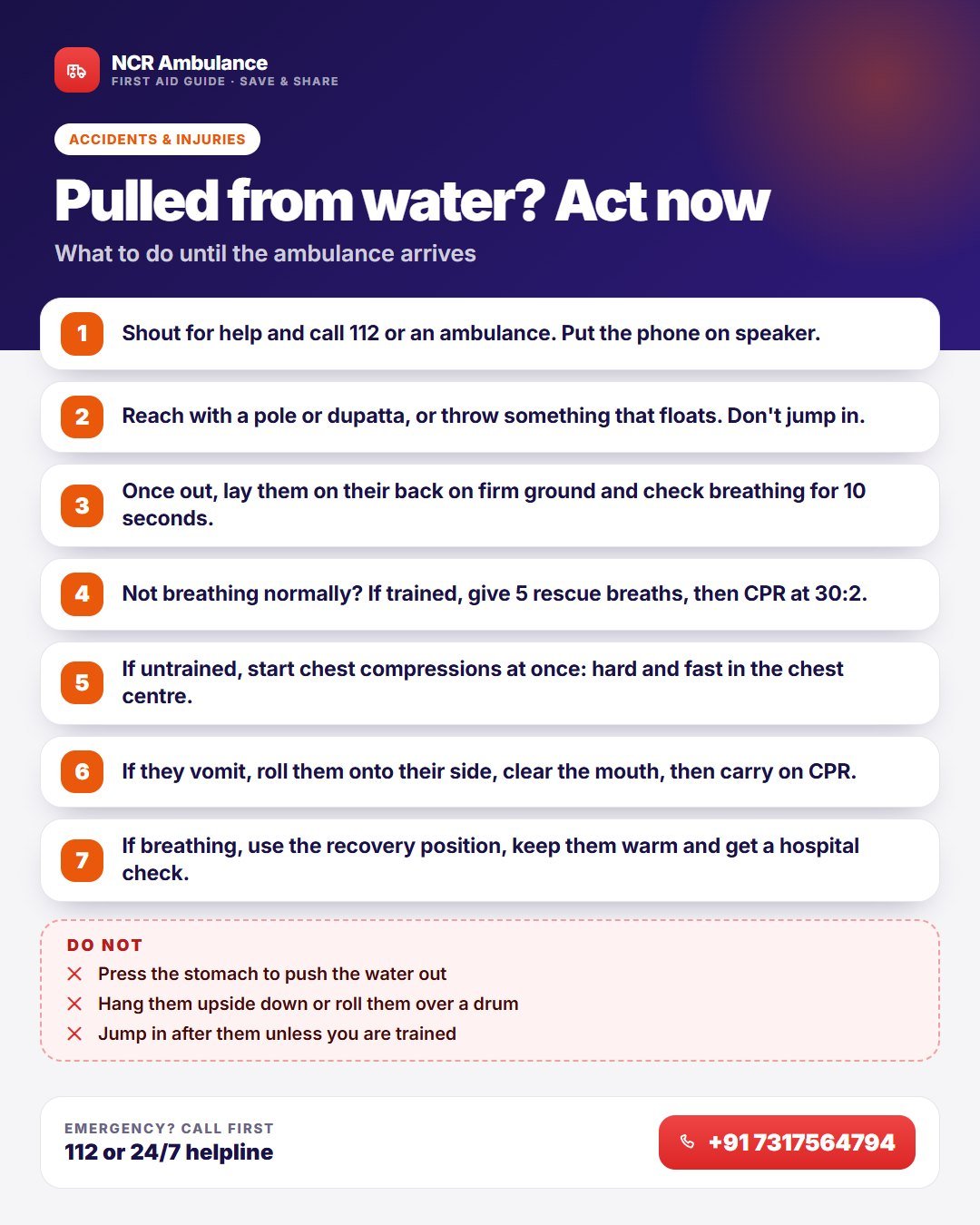
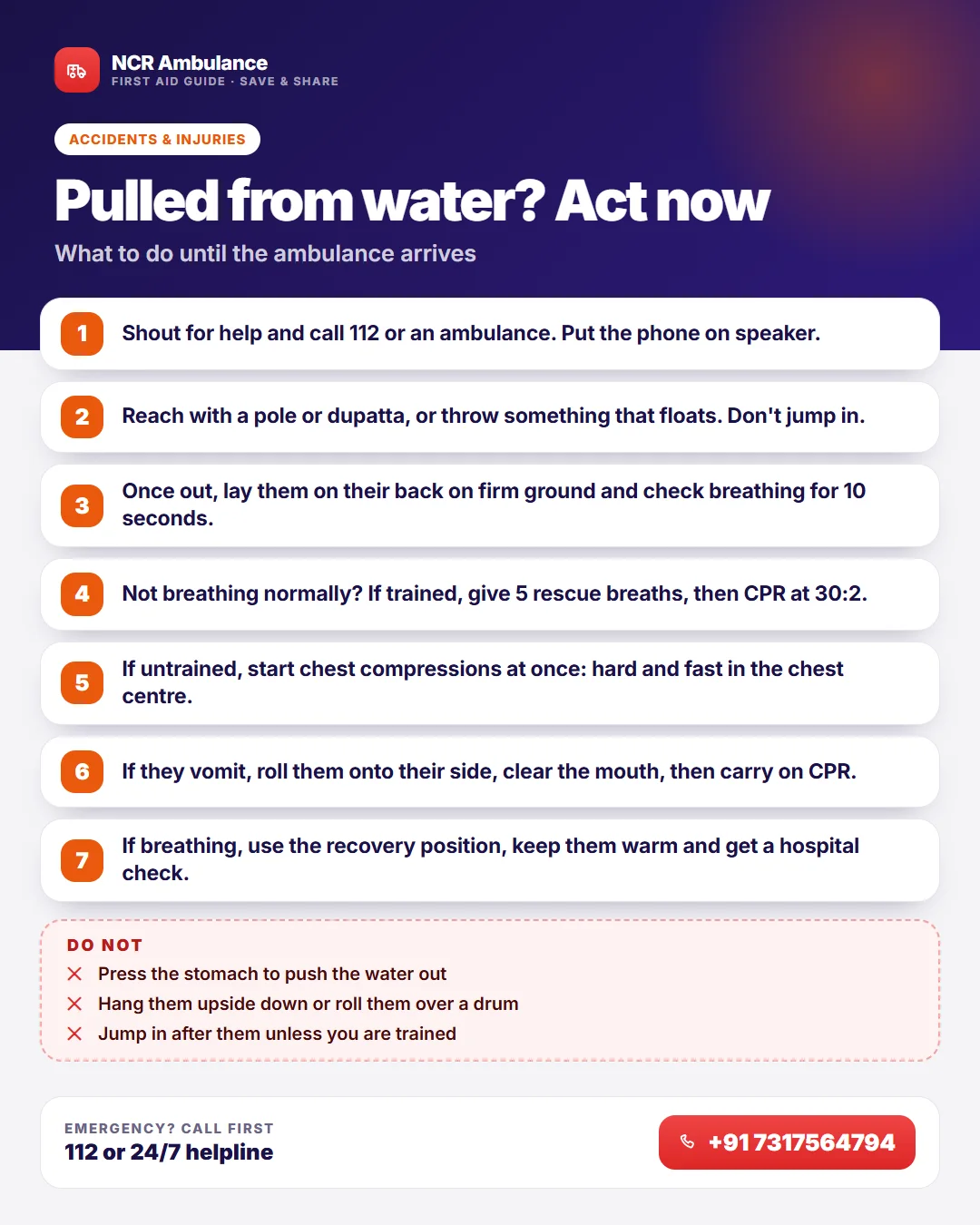
Pulled from water? Act now
- Shout for help and call 112 or an ambulance. Put the phone on speaker.
- Reach with a pole or dupatta, or throw something that floats. Don't jump in.
- Once out, lay them on their back on firm ground and check breathing for 10 seconds.
- Not breathing normally? If trained, give 5 rescue breaths, then CPR at 30:2.
- If untrained, start chest compressions at once: hard and fast in the chest centre.
- If they vomit, roll them onto their side, clear the mouth, then carry on CPR.
- If breathing, use the recovery position, keep them warm and get a hospital check.
Do not
- Press the stomach to push the water out
- Hang them upside down or roll them over a drum
- Jump in after them unless you are trained
In this guide
- What drowning really looks like
- How to rescue a drowning person safely: reach, throw, don't go
- Drowning first aid: step by step after they are out of the water
- If things get worse: when to restart CPR
- Why everyone rescued from water needs a hospital check
- Where drowning happens in Delhi NCR, and how to prevent it
- Drowning first aid: quick do's and don'ts
Drowning is fast and almost silent. A toddler tips into a bucket or an open water tank while the family is busy, a child goes under at the deep end of a society pool in Gurugram while the adults chat nearby, or a group of friends wades into a canal or the Yamuna on a hot afternoon and one of them doesn't come back up. There is rarely shouting or splashing. By the time anyone notices, the person may already have stopped breathing.
This guide explains what an ordinary bystander can do: how to get someone out of the water without becoming a second victim, how CPR for drowning differs from CPR after a heart attack, and how to look after them until an ALS ambulance with oxygen and airway equipment arrives. You don't need to be a swimmer or a doctor. You need to stay safe, act quickly and get oxygen back into their body.
What drowning really looks like
Films show drowning people waving and screaming. In real life, a person who is drowning usually can't call out, because all their effort goes into keeping their mouth above the water. Watch for:
- Head low in the water, mouth at water level, head tilted back.
- An upright body with little or no kicking, as if climbing an invisible ladder.
- Glassy or closed eyes, hair over the face, gasping or bobbing.
- Silence. A child who was splashing noisily and has suddenly gone quiet needs checking at once.
Young children often don't struggle at all. Toddlers are top-heavy, so once they tip into a bucket, a bathtub or a paddling pool they can't lift their head out, and they can drown in a few centimetres of water.
How to rescue a drowning person safely: reach, throw, don't go
A panicking person in water grabs whatever is near them, including the rescuer, and can push them under. Too often, a drowning claims the would-be rescuer as well. Lifeguards follow a simple rule, and so should you:
- Reach. Lie flat on the edge or hold on to something fixed, then reach out with a long object: a bamboo pole, a branch, an oar, a belt, a rope, or a dupatta or saree twisted into a rope. Pull them in slowly while staying low so you aren't dragged in.
- Throw. If they are too far away, throw anything that floats: a life ring, an empty plastic can or water bottle with the cap on, a thermocol sheet, a cooler box or an inflated tyre tube. Throw it close to them and shout to them to hold on and kick.
- Don't go. Don't jump in unless you are trained in water rescue. Rivers, canals and flooded drains hide currents, deep mud and debris. If you are a strong swimmer and must go in, take something that floats and push it to them rather than letting them grab you.
The exception is shallow water where you can stand safely, such as a bucket, a bathtub or the shallow end of a pool: lift the child out immediately. Shout for help while you work, and get someone to call 112 or an ambulance straight away.
Drowning first aid: step by step after they are out of the water
Step 1: Call for an ambulance
If someone else is with you, one person calls while the other starts first aid. If you are alone, call 112 or our 24/7 helpline (+91 7317564794), put the phone on speaker and start first aid while you talk. If you have no phone, give about one minute of CPR before you leave to get help. Tell the dispatcher: "Drowning, pulled from water, not breathing" (or "breathing but drowsy"), then the exact location with a landmark or gate number.
Step 2: Check whether they are breathing
Lay them on their back on a firm, flat surface, away from the water's edge. Tap their shoulders and shout their name. If they don't respond, gently tilt the head back and lift the chin to open the airway, then look, listen and feel for normal breathing for no more than 10 seconds. Occasional gasps are not normal breathing.
If they dived into shallow water or were hit by something, they may have a neck injury. Move the head as little as possible, but don't let that stop you opening the airway: breathing comes first. Our guide to neck and spine injury first aid explains how to protect the neck.
Step 3: Not breathing? Rescue breaths first, then CPR
When the heart stops in drowning, it is usually because the body has run out of oxygen, not because of a sudden heart rhythm problem. That's why CPR for drowning starts with breaths.
- If you are trained: give 5 rescue breaths. Pinch the nose, seal your mouth over theirs and blow steadily for about one second, watching the chest rise. Then start chest compressions and continue with 30 compressions to 2 breaths.
- If you are not trained, or can't give breaths: start chest compressions immediately. Push hard and fast in the centre of the chest, 100 to 120 times a minute. Compressions alone are far better than doing nothing.
Keep going until the ambulance crew takes over, the person starts breathing normally, or you physically can't continue. Our step-by-step CPR guide for adults shows hand position and depth. For children and babies, breaths matter even more and the technique is gentler: see how to give CPR to a child or baby. If there is an AED at the pool or clubhouse, send someone for it, move the person away from standing water, wipe the chest dry and follow the voice prompts.
Step 4: Don't try to get the water out
Pressing on the belly, rolling the person over a drum or holding a child upside down to "drain the water" is one of the most common first-aid myths in India. The amount of water in the lungs is usually small, and the body absorbs it. These manoeuvres waste the minutes the brain needs oxygen, and they push water and food up from the stomach, which can then be breathed into the lungs. Give breaths and compressions instead.
Step 5: If they vomit, turn them on their side
Vomiting is very common during CPR after drowning. If it happens, roll them onto their side quickly, keeping the head, neck and body in line, let the vomit drain out and wipe the mouth clean with a cloth. Then roll them onto their back and carry on with CPR.
Step 6: Keep them warm and watch them closely
If they are breathing, or start breathing again, put them in the recovery position so the airway stays clear. Our guide to first aid for an unconscious person shows how. Remove wet clothes if you can do it without moving them too much, and cover them with dry towels, blankets or a jacket. Even in a Delhi summer, someone who has been in water loses body heat, and cold water in winter is a danger in itself.
Stay with them and keep checking their breathing. Don't give food or drink, and don't let them walk around "to recover". Even if they seem fine, they need a hospital check.
If things get worse: when to restart CPR
Keep watching their breathing until the crew arrives, because a rescued person can get worse after seeming to recover.
- If they stop breathing normally, roll them onto their back and start CPR again, beginning with rescue breaths if you are trained.
- If they become drowsy, confused or hard to wake, keep them in the recovery position and tell the dispatcher.
- If their breathing becomes fast, noisy or laboured, or their lips turn blue or grey, update the dispatcher, who may send a ventilator ambulance for breathing support.
Don't stop CPR because you think they were underwater for too long. You can't judge that at the scene. Keep going and let the ambulance crew and doctors decide.
Why everyone rescued from water needs a hospital check
Water that enters the lungs, even a small amount, can irritate them and make it harder for oxygen to pass into the blood. A person may cough, seem to recover, and then develop breathing problems over the next few hours. That's why anyone who needed rescuing, lost consciousness, needed breaths or CPR, or kept coughing afterwards should be checked in a hospital emergency department, even if they look well.
| After a water incident, if the person is… | What to do |
|---|---|
| Not breathing normally | Call 112, start CPR (breaths first if trained), send for an AED |
| Breathing but drowsy, confused or unresponsive | Recovery position, keep warm, ambulance now |
| Awake but coughing a lot, breathless or vomiting | Ambulance or emergency department now |
| Rescued or went under, now seems well | Hospital check, then watch closely for the rest of the day |
| Swallowed a mouthful while playing, coughed briefly, now completely normal | Watch at home and get help if any warning sign appears |
Forwarded messages sometimes warn that a child can "drown on dry land" days after swimming. These aren't medical terms, and doctors don't use them, so there's no need to panic every time a child swallows some pool water. What is real is that breathing problems from inhaled water can appear in the hours after a genuine scare, usually with signs you can notice. Keep an eye on the child for the rest of the day, and if you are worried, get them checked.
Get urgent help if, in the hours after being in the water, the person has a cough that won't settle, fast or difficult breathing, chest pain, vomiting, unusual sleepiness or confusion, or blue lips.
Where drowning happens in Delhi NCR, and how to prevent it
Drownings in Delhi NCR often happen in places that don't look dangerous:
- Homes: buckets, tubs and drums of stored water, and open underground or terrace tanks. Toddlers are most at risk.
- Swimming pools: society, hotel, school and farmhouse pools, especially at parties where everyone assumes someone else is watching the children.
- Rivers, canals and ponds: the Yamuna, canals and village ponds, particularly in summer heat, during festival immersions or ritual bathing, and after drinking alcohol.
- Monsoon hazards: waterlogged underpasses, flooded basements and rain-filled pits at construction sites.
A few habits prevent most of these deaths:
- Empty buckets and tubs after use, and keep lids on tanks and drums.
- Never leave a young child alone near water, even for a moment to answer the door.
- At pool parties, choose one adult as the "water watcher" who stays off their phone.
- Swim only where there is a lifeguard, never in rivers or canals, and never after alcohol.
- Teach children to swim, and learn CPR yourself.
If your family spends weekends at pools and farmhouses on the edge of the city, save the number for our ambulance service in Gurgaon along with your society's emergency contacts.
Drowning first aid: quick do's and don'ts
Do
- Shout for help and call 112 or an ambulance
- Reach or throw something that floats
- Give 5 rescue breaths, then CPR, if you are trained
- Start chest compressions straight away if you aren't
- Turn them on their side if they vomit
- Keep them warm and get them checked in hospital
Don't
- Jump in unless you are trained in water rescue
- Press the stomach or hang them upside down
- Waste time trying to drain water from the lungs
- Let them go home without a medical check
- Stop CPR because you think it's too late
Drowning gives very little warning, but the first few minutes after a rescue are in your hands. Get them out safely, get oxygen into them with breaths and compressions, and keep going until help takes over. Save our number in your phone today: +91 7317564794. Our 24/7 emergency ambulance service in Delhi NCR covers homes, pools and riverbanks across the region, and you can call our emergency ambulance helpline any time, day or night.
Save it. Share it.
Keep this step-by-step card on your phone
Emergencies rarely give you time to search. Save this card or share it in your family and society WhatsApp groups. One person who knows what to do can save a life.
Frequently asked questions
Should I press the stomach to get water out after drowning?
No. The real danger in drowning is lack of oxygen, not the water itself, and the amount of water in the lungs is usually small. Pressing the stomach, rolling the person over a drum or holding a child upside down wastes precious minutes and often makes them vomit, and the vomit can then be breathed into the lungs. Open the airway, give rescue breaths if you are trained and start chest compressions.
What is secondary drowning or dry drowning?
These are popular terms, not medical ones, and doctors avoid using them. They describe something real: breathing problems that develop in the hours after someone inhales water. Warning signs include a cough that won't settle, fast or difficult breathing, chest pain, vomiting, and unusual sleepiness or confusion. If any of these appear after a scare in the water, call an ambulance or go to an emergency department straight away.
Is CPR different for a drowning victim?
Yes. In drowning, the heart usually stops because the body has run out of oxygen, so breaths are especially important. Trained rescuers give 5 rescue breaths first, then continue with 30 chest compressions to 2 breaths. If you are not trained or can't give breaths, start chest compressions immediately. Compression-only CPR is still far better than waiting for the ambulance and doing nothing.
Should I jump into the water to save someone who is drowning?
Only if you are trained in water rescue. A panicking person can grab a rescuer and pull them under, and rivers and canals around Delhi NCR can hide strong currents and deep mud. First try to reach them with a pole, rope or dupatta, or throw something that floats, such as an empty plastic can with its lid on. Shout for help and get someone to call 112.
Can a small child drown in a bucket of water?
Yes. Toddlers are top-heavy, and if they tip head-first into a bucket, tub or drum they often can't push themselves back out. Drowning can happen in a few centimetres of water, within minutes and without any noise. Empty buckets and tubs straight after use, keep lids on water tanks and drums, and never leave a young child alone in the bathroom, even for a moment.
Does someone who seems fine after nearly drowning still need a doctor?
Yes, if they needed rescuing, went under, lost consciousness, needed breaths or CPR, or kept coughing afterwards. Inhaled water can irritate the lungs and cause breathing problems that build up over the following hours. A hospital check lets doctors examine the chest and monitor oxygen levels. If they cough, vomit, or become breathless or drowsy at home, call an ambulance immediately.
Ambulance services for this emergency
24/7 coverage: Ambulance service in DelhiAmbulance service in GurgaonAmbulance service in NoidaAmbulance service in GhaziabadAmbulance service in FaridabadAmbulance service in Greater NoidaAmbulance service in Dwarka