Until the ambulance arrives
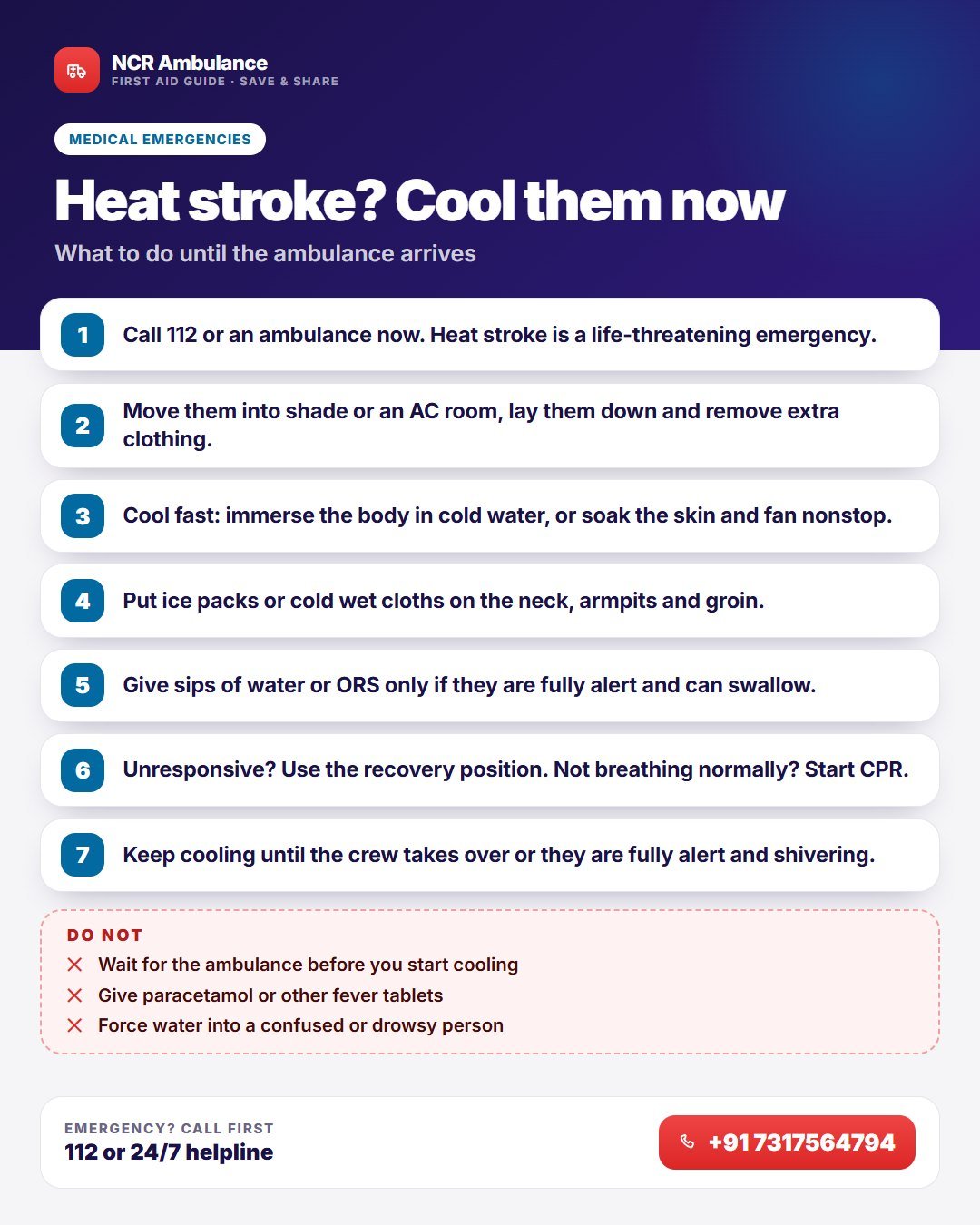
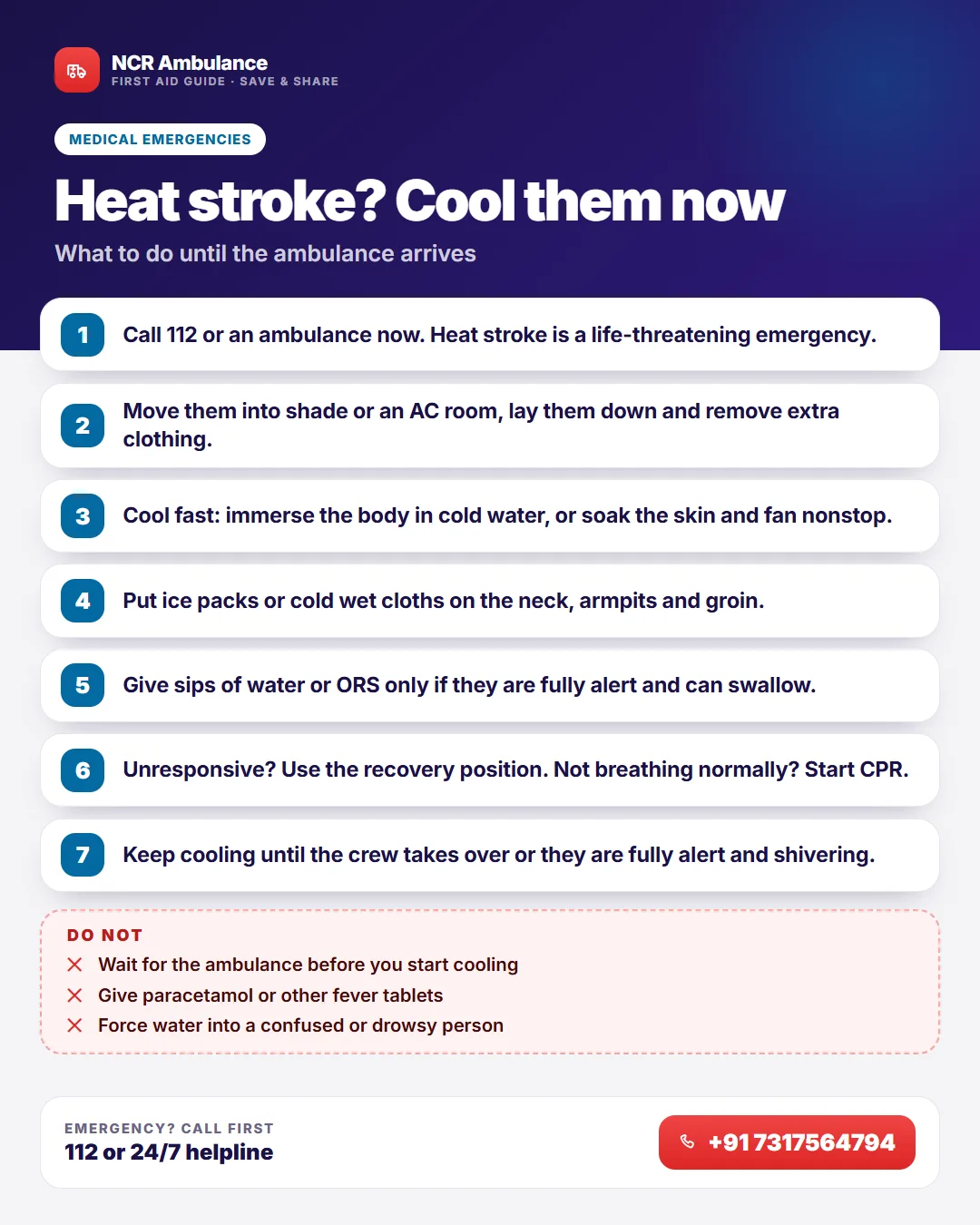
Heat stroke? Cool them now
- Call 112 or an ambulance now. Heat stroke is a life-threatening emergency.
- Move them into shade or an AC room, lay them down and remove extra clothing.
- Cool fast: immerse the body in cold water, or soak the skin and fan nonstop.
- Put ice packs or cold wet cloths on the neck, armpits and groin.
- Give sips of water or ORS only if they are fully alert and can swallow.
- Unresponsive? Use the recovery position. Not breathing normally? Start CPR.
- Keep cooling until the crew takes over or they are fully alert and shivering.
Do not
- Wait for the ambulance before you start cooling
- Give paracetamol or other fever tablets
- Force water into a confused or drowsy person
In this guide
It's a May afternoon in Gurgaon and the temperature has crossed 45°C. A delivery rider who has been on the road since morning stumbles off his bike outside an office tower and sits on the pavement, mumbling. The guard sprinkles water on his face and offers him a cold drink, thinking he is just tired. But his skin is burning hot, he can't say where he is, and his body's cooling system has failed.
Heat stroke is a medical emergency that can damage the brain, kidneys and heart within a short time. The most useful thing a bystander can do is cool the person fast while help is on the way. This guide explains how to recognise heat stroke, how it differs from heat exhaustion, the quickest ways to cool someone and what to do until the emergency ambulance arrives.
What is heat stroke?
Normally the body keeps its core temperature around 37°C by sweating and sending warm blood to the skin. In extreme heat, especially with humidity, hard physical work or dehydration, this system can be overwhelmed. In heat stroke the core temperature rises above 40°C and the brain starts to malfunction. The higher it climbs and the longer it stays there, the more damage it does to the brain, kidneys, liver and muscles.
There are two common patterns. Classic heat stroke builds up over a day or more during a heatwave, usually in elderly or ill people, often indoors in a hot room. Exertional heat stroke strikes fit, often young people doing hard work or exercise in the heat, such as labourers, riders and athletes, and can develop within hours.
Signs of heat stroke
- Confusion or strange behaviour: agitation, irritability, not making sense, not knowing where they are. This is the key sign.
- Slurred speech or staggering, as if drunk.
- Very hot skin. It may be dry, but in exertional heat stroke the person is often still sweating, so sweat does not rule it out.
- A fast heartbeat and fast breathing.
- Headache, nausea or vomiting.
- Seizures (fits), collapse or unconsciousness.
A home thermometer under the arm or in the mouth often reads lower than the true core temperature, so don't rely on the number. A very hot person who is confused, slurring or collapsing has heat stroke until proven otherwise.
Heat stroke vs heat exhaustion: how to tell the difference
Heat exhaustion usually comes first and is a warning. Heat stroke is the emergency. The main difference is in the brain: in heat exhaustion the person is still thinking clearly.
| Heat exhaustion | Heat stroke | |
|---|---|---|
| Mental state | Alert, answering normally | Confused, agitated, slurring, drowsy or unconscious |
| Skin | Pale, cool and moist, with heavy sweating | Hot and flushed; may be dry or still sweaty |
| Temperature | Normal or raised, below 40°C | Above 40°C |
| Other signs | Weakness, dizziness, headache, nausea, muscle cramps, thirst | Seizures, collapse, vomiting, fast breathing |
| What to do | Rest in a cool place, cool them, give water or ORS | Call an ambulance and start cooling immediately |
Heat exhaustion can turn into heat stroke if the person stays in the heat. If they don't improve within 30 minutes of resting and cooling, or they become confused at any point, treat it as heat stroke and call for help.
What to do for heat stroke: step by step
Step 1: Call 112 or an ambulance
Call straight away, or ask someone else to call while you start cooling. Put the phone on speaker. Say: "Suspected heat stroke, very hot and confused (or unconscious)," and give the exact location with a landmark. If the person is unstable, an ICU ambulance for critical patients may be needed to take them to a hospital with intensive care.
Step 2: Move them somewhere cool
Get the person out of the sun immediately: into shade, an air-conditioned room, a shop or office lobby, or a car with the AC running. Lay them down. Remove helmets, jackets, uniforms, shoes, socks and any extra layers.
Step 3: Cool them as fast as you can
This is the step that saves lives. Don't wait for the ambulance to start it. Use the most effective method you have:
- Cold-water immersion (most effective): if a bathtub, a large tub or a water drum is available, put the body in cold water up to the neck, keeping the head out and supported. Someone must hold the person the whole time.
- Soak and fan: if immersion isn't possible, keep pouring cool or cold water over the whole body with buckets, mugs or a hose, and fan hard with a ceiling fan, table fan, hand fan or newspaper. The evaporating water carries heat away. Wet sheets or towels also work if you keep re-wetting them and keep fanning.
- Ice packs: place ice packs, ice wrapped in cloth, frozen vegetable packets or cold wet cloths on the neck, armpits and groin, where large blood vessels run close to the skin.
Keep cooling until the ambulance crew takes over, or until the person is fully alert again and starts to shiver. Then stop the ice but keep them in a cool place, because their temperature can rise again.
Step 4: Give fluids only if they are fully alert
If the person is awake, thinking clearly and able to swallow, give small sips of cool water or ORS. If they are confused, drowsy, vomiting or unconscious, give nothing by mouth, because they may choke or breathe the fluid into their lungs. Sips are enough while you concentrate on cooling.
Step 5: Watch them closely
Stay with them and keep checking whether they respond to you and are breathing normally. Note the time they collapsed and what they were doing beforehand, and tell the crew. Don't let them get up and walk, even if they start to feel better.
Paracetamol and other fever medicines lower a fever caused by infection, but heat stroke is not that kind of fever. These tablets won't bring the temperature down and only waste precious time. Rubbing alcohol on the skin is also a bad idea: it can be absorbed, especially in children, and plain water with fanning works better. Folk beliefs, like keeping an onion in the pocket or avoiding cold water "because it causes shock", have no place here. Read more in our guide to common first-aid myths in India.
If they become unresponsive or stop breathing
- Unresponsive but breathing normally: turn them into the recovery position so the airway stays open, and keep cooling with water, fanning and ice packs. Our guide to helping an unconscious person shows how.
- Seizure: clear the space around them, cushion the head and don't hold them down or put anything in the mouth. See first aid for a seizure.
- Not breathing normally (no breathing, or only occasional gasps): start hands-only CPR immediately and keep going until help arrives. Follow our CPR guide for bystanders.
Who is most at risk in Delhi NCR summers?
Delhi NCR's heatwaves usually peak in May and June. They are especially dangerous because the heat often doesn't let up at night, and in the humid weeks around the monsoon, sweat evaporates poorly and cools the body less. The people most at risk are:
- Elderly people, especially those living alone, in top-floor flats or in homes without cooling during power cuts. Older bodies sense heat and thirst less well.
- Babies and young children. Never leave a child in a parked car, even for a few minutes, because the inside heats up very quickly.
- Outdoor workers: delivery riders, construction workers, traffic police, security guards, street vendors, rickshaw drivers and farm labourers.
- People exercising outdoors, such as runners and cricketers, and anyone wearing heavy protective clothing.
- People with long-term illnesses such as heart disease, diabetes, kidney disease or obesity, and those on certain medicines, including water tablets (diuretics), some blood pressure medicines and some psychiatric medicines.
- Anyone who has been drinking alcohol, which dehydrates the body.
How to prevent heat stroke
The National Disaster Management Authority (NDMA) issues heatwave advice every summer. The key points are:
- Drink water often, even if you are not thirsty. ORS, lassi, nimbu pani and chhaas (buttermilk) also help.
- Avoid going out in the sun, especially between noon and 3 pm, and do heavy work in the cooler morning or evening hours.
- Wear light-coloured, loose cotton clothes, and cover your head with a cap, gamchha or umbrella.
- Avoid alcohol, and cut down on tea, coffee and fizzy drinks, which can dehydrate the body.
- Keep your home cool with curtains or shades on the sunny side, and open the windows at night.
- Check on elderly neighbours and relatives at least twice a day during a heatwave.
Employers can help too, by giving outdoor staff shade, drinking water and regular rest breaks, and by moving the heaviest work away from the afternoon.
Heat stroke first aid: quick do's and don'ts
Do
- Call for help and start cooling at the same time
- Move them into shade or an AC room
- Soak them with water and fan nonstop
- Put ice packs on the neck, armpits and groin
- Give sips of water only if they are fully alert
Don't
- Wait for the ambulance before you start cooling
- Give paracetamol or other fever tablets
- Rub alcohol on the skin
- Force fluids into a confused or drowsy person
- Leave them alone or send them back to work
Heat stroke is one of the few emergencies where what you do in the first minutes, cooling the body hard and fast, can make a big difference to how well the person recovers. Save our number before the next heatwave: +91 7317564794. Our dispatch team arranges emergency ambulance service in Gurgaon and ambulance service in Delhi as part of a 24/7 emergency ambulance service across Delhi NCR.
Save it. Share it.
Keep this step-by-step card on your phone
Emergencies rarely give you time to search. Save this card or share it in your family and society WhatsApp groups. One person who knows what to do can save a life.
Frequently asked questions
Does paracetamol like Crocin or Dolo help in heat stroke?
No. Paracetamol lowers a fever caused by an infection by resetting the brain's thermostat. In heat stroke the thermostat has not been reset; the body has simply been overwhelmed by heat, so fever tablets don't bring the temperature down. What works is physical cooling: cold water, wet cloths, fanning and ice packs, started as early as possible and continued until the ambulance crew takes over.
Should I give ORS or water to someone with heat stroke?
Only if they are fully awake, thinking clearly and able to swallow without coughing. Then small, frequent sips of cool water or ORS are fine. If they are confused, drowsy, vomiting or unconscious, give nothing by mouth, because the fluid can go into the lungs. Drinking water will not cool someone with heat stroke quickly enough anyway. Cooling the skin from outside is what matters most.
Is it safe to use ice or very cold water on someone with heat stroke?
Yes. Cold water and ice are exactly what emergency teams use, and fast cooling gives the best chance of a good recovery. Don't hold back because of the old belief that cold water causes shock. Keep the head out of the water, hold the person securely and stop the ice once they are alert and start shivering. For frail elderly people, soaking and fanning is often easier than a tub.
Can heat stroke happen indoors or at night?
Yes. During Delhi heatwaves, nights often stay very warm, and top-floor flats, tin-roofed rooms and homes without cooling during power cuts can become dangerously hot. Elderly people and those with long-term illness can develop heat stroke slowly over a day or two without ever going outside. Check on them often, keep them in the coolest room and watch for confusion or unusual drowsiness.
What body temperature means heat stroke?
Doctors diagnose heat stroke when the core body temperature is above about 40°C along with confusion, seizures or collapse. A thermometer under the arm or in the mouth usually reads lower than the true core temperature, so a lower reading does not rule it out. If someone is very hot and their behaviour or alertness changes, start cooling them and call an ambulance.
Is 'loo lagna' the same as heat stroke?
People in North India often say someone has 'loo lag gayi' when they fall ill after the hot summer winds. This can mean anything from mild heat exhaustion to true heat stroke. What matters is the person's mental state. If they are confused, slurring, fitting or unconscious, treat it as heat stroke: call an ambulance and start cooling immediately, without waiting for home remedies.
Ambulance services for this emergency
24/7 coverage: Ambulance service in DelhiAmbulance service in GurgaonAmbulance service in NoidaAmbulance service in GhaziabadAmbulance service in FaridabadAmbulance service in Greater NoidaAmbulance service in Dwarka
Related first-aid guides
 Brain & Consciousness
Unconscious Person First Aid: What to Do if Someone Faints
 Brain & Consciousness
Seizure First Aid: What to Do When Someone Has a Fit or Mirgi
 Heart & Breathing
How to Do CPR: Step-by-Step Hands-Only CPR for Adults
 Be Prepared
First-Aid Myths in India: 12 Dangerous Mistakes to Avoid