Until the ambulance arrives
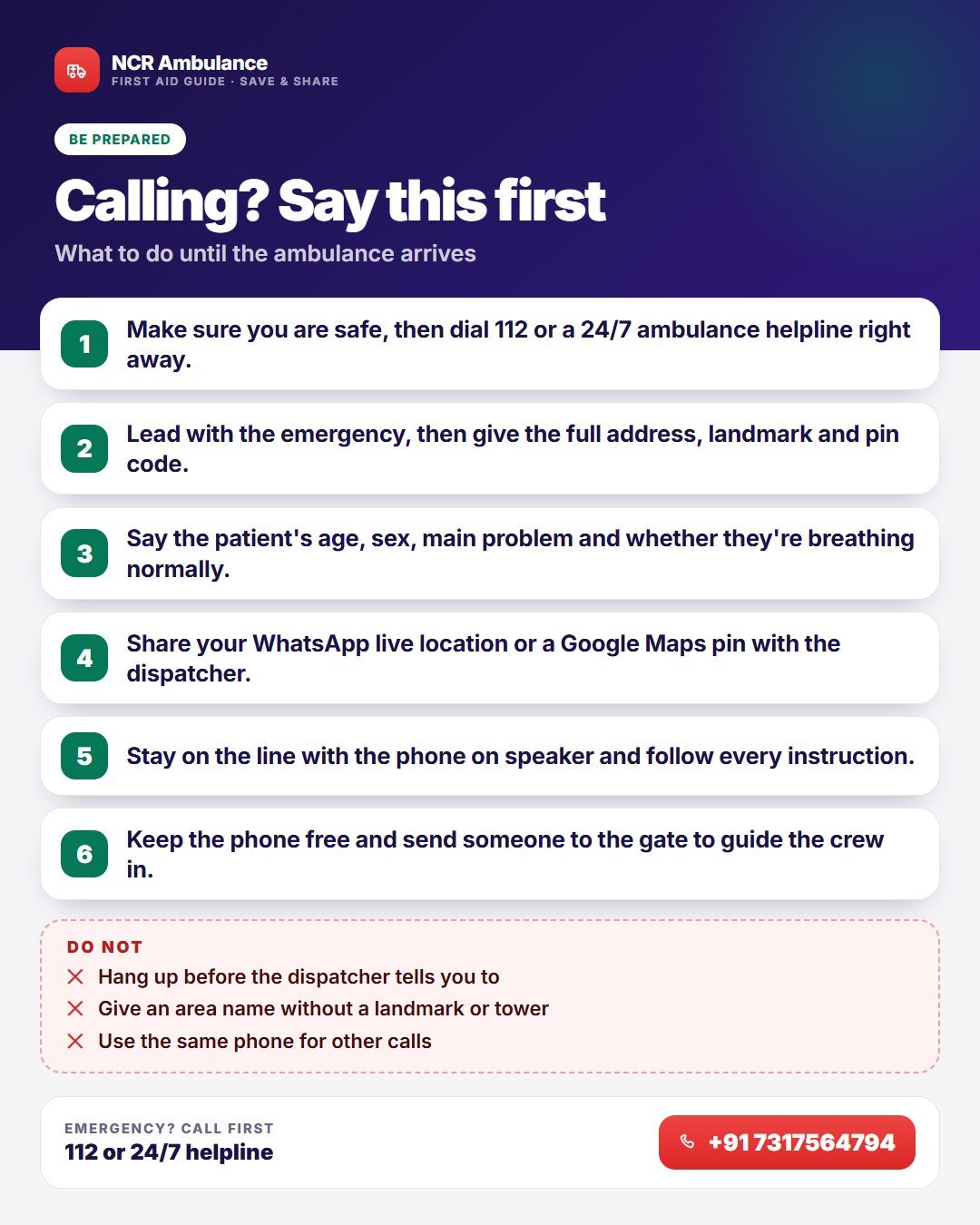
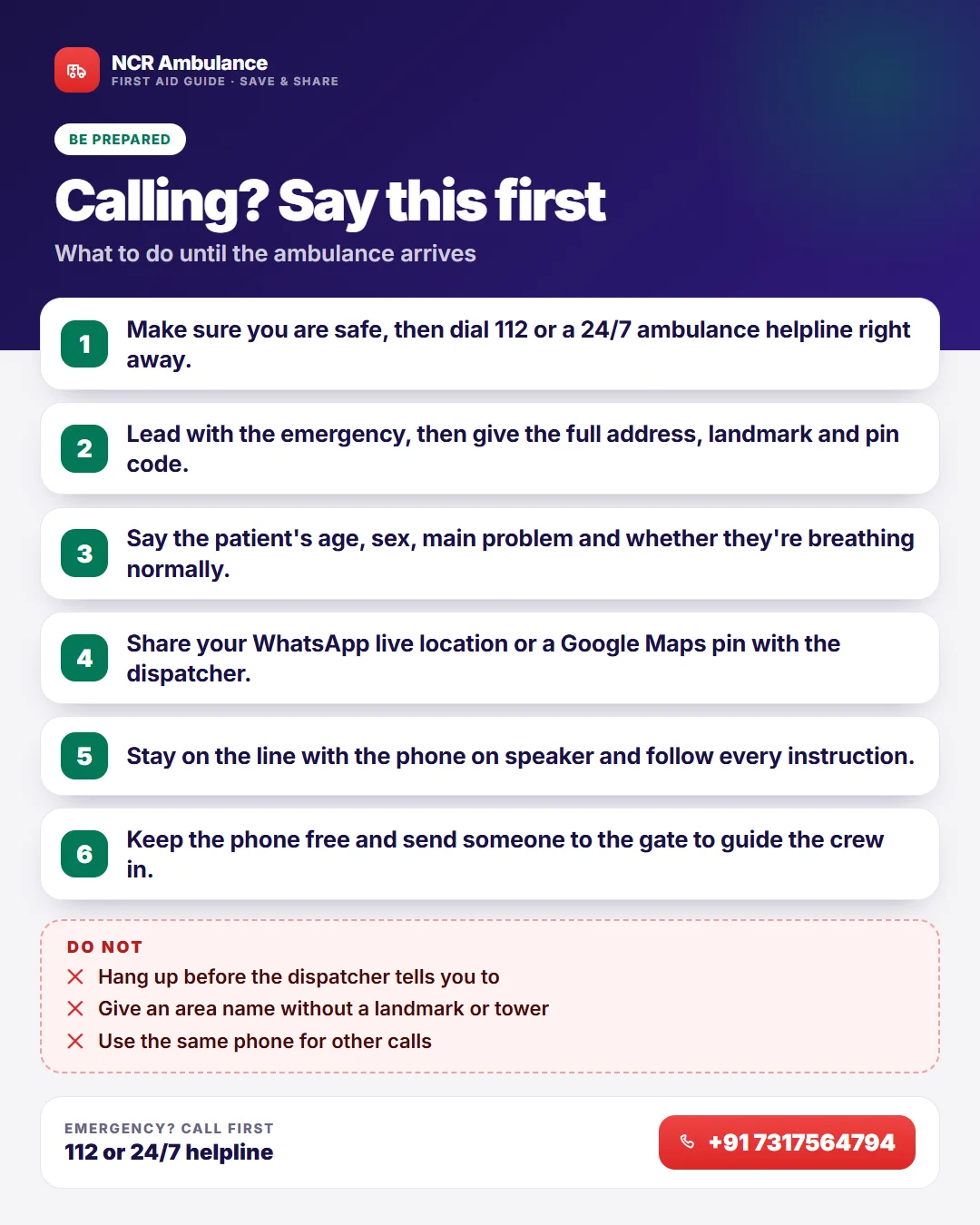
Calling? Say this first
- Make sure you are safe, then dial 112 or a 24/7 ambulance helpline right away.
- Lead with the emergency, then give the full address, landmark and pin code.
- Say the patient's age, sex, main problem and whether they're breathing normally.
- Share your WhatsApp live location or a Google Maps pin with the dispatcher.
- Stay on the line with the phone on speaker and follow every instruction.
- Keep the phone free and send someone to the gate to guide the crew in.
Do not
- Hang up before the dispatcher tells you to
- Give an area name without a landmark or tower
- Use the same phone for other calls
In this guide
It is 2 a.m. Your father has collapsed in the bathroom, your hands are shaking, and when the call connects you can't remember your own pin code. This happens to calm, capable people every day. A few seconds of confusion on the phone can turn into many minutes lost on the road.
This guide explains which numbers to dial in Delhi NCR, exactly what the dispatcher needs to hear, how to share a precise location, and what to do until help reaches you. It includes a ready-to-use script you can screenshot. Whether you call 112, a state ambulance number or our 24/7 emergency ambulance service in Delhi NCR, the same rules apply.
Which numbers can you call for an ambulance in Delhi NCR?
You have more than one option, and it helps to know them before an emergency, not during one.
| Number | What it connects to | Good to know |
|---|---|---|
| 112 | India's single emergency number for police, fire and ambulance | Works across states, so it's the one number to remember anywhere in Delhi NCR |
| 102 / 108 | State government ambulance services | Which number applies, and for what, varies by state. In many states 108 is for emergencies and 102 is for pregnant women and young children |
| Private 24/7 helpline | A private ambulance booking and dispatch service | You can ask for a specific type of ambulance, such as ICU, ALS or ventilator, and choose the hospital |
Delhi NCR spans three states: Delhi, Haryana (Gurgaon and Faridabad) and Uttar Pradesh (Noida, Greater Noida and Ghaziabad). The state number that works at your home may not be the one that works at your office. Find out which number applies where you live and work, save it in your phone, and save a private 24/7 helpline as a backup.
Government ambulance services do vital work and handle a large share of emergencies across the region. A private helpline is useful when you want a particular level of care, such as an ICU ambulance for a critically ill patient, or when you want the patient taken to the hospital that already has their records. If you're unsure which type to ask for, our guide on choosing between BLS, ALS and ICU ambulances explains the difference. In a true emergency, call whichever number you can reach fastest.
How to call an ambulance: step by step
Step 1: Make sure you are safe, then check the patient
Take two seconds to look around. At a road accident, watch for traffic, leaking fuel or fire. At home, switch off the mains before touching someone who has had an electric shock. Then check whether the person responds when you tap their shoulders and speak loudly, and whether they are breathing normally. The dispatcher will ask you both questions. If you are calling for a stranger, remember that India's Good Samaritan law protects people who help.
Step 2: Dial and say what you need first
Call 112 or your ambulance helpline. Start with the most important facts: "I need an ambulance. My father has collapsed and is not breathing properly." The dispatcher will ask for more, but leading with the emergency helps them understand how urgent your call is.
Step 3: Give the exact location
This is the information most often given badly. The dispatcher needs:
- The house or flat number, the floor, and the tower or block
- The society, colony or sector name, the city and the pin code
- A well-known landmark nearby: a temple, school, metro station, petrol pump or mall
- Which gate to use, if your society or campus has several
Step 4: Describe the patient in a few words
- Age and sex: "a 68-year-old man"
- The main problem: chest pain, a fall, a fit, breathing trouble, bleeding or burns
- Conscious and breathing? Say clearly whether they respond to you and are breathing normally
- How many patients, and any hazards such as fire, gas or traffic
- Known conditions, if you know them: heart disease, diabetes, pregnancy
Answer the questions in the order you're asked. They are designed to help the dispatcher send the right help quickly.
Step 5: Share a live location
If the helpline uses WhatsApp, send your live location as well as saying the address (the next section explains how). A map pin removes the guesswork, especially at night or in a large township where many towers look the same.
Step 6: Stay on the line and follow instructions
Don't hang up until the dispatcher tells you to. Put the phone on speaker so your hands are free. You may be asked to unlock the door, turn the patient on their side or start CPR. Do exactly what you are told, and say at once if anything changes.
Step 7: Keep the phone free and guide the crew in
After the call, don't use that phone for anything else, because the ambulance crew may ring you for directions. Send someone to the gate or the main road to wave the ambulance in, and tell the society guard it is coming. Our checklist for families waiting for an ambulance covers the gate, the lift and the documents to keep ready.
"I need an ambulance at [flat number, floor, tower], [society or colony], [sector or area], [city], pin code [number]. The nearest landmark is [landmark]. The patient is a [age]-year-old [man or woman] with [main problem]. They are [conscious or not conscious] and [breathing normally or not breathing normally]. My number is [number]. I'm sending my WhatsApp location now."
Fill in your home address in this script now, while you are calm, and save it in your phone's notes. Many families also stick a printed copy on the fridge for elderly parents, domestic help and drivers.
How to share your exact location
Addresses in Delhi NCR can be confusing: new sectors, repeated block letters, societies with five gates. A map pin is the surest way to be found.
- WhatsApp live location: open the chat, tap the attachment icon (a paperclip or plus sign), choose Location, then Share live location. Pick a duration of an hour or more so the crew can still see you if you move.
- Google Maps pin: open Google Maps and tap the blue dot that shows where you are, then use the share option. You can also press and hold on your building to drop a pin and share that.
- Say the landmark anyway: GPS can be off by a building or two in crowded colonies, and phones lose signal in basements and lifts.
- On a highway or expressway: say which direction you were travelling, and the nearest exit, toll plaza, flyover or kilometre stone.
- Near the metro: elevated metro pillars carry numbers. Reading out the pillar number gives the crew a precise point to head for.
Calling from each city in Delhi NCR
The basics are the same everywhere, but each city has its own address quirks. These tips help the crew reach you without circling the block.
- Delhi: give the colony, block and house number, because the same block letters repeat across many colonies. Near an elevated metro line, a pillar number is a reliable landmark. Read more about our ambulance service in Delhi.
- Gurgaon: say the sector, the society name and the tower, plus the nearest main road. Large gated societies often have several gates, so name the one the ambulance should use. Save the guard room's number next to our emergency ambulance service in Gurgaon.
- Noida: sector numbers make Noida addresses easier to find, but always add the block and the plot or flat number. If you are near an expressway, mention the nearest exit or underpass. See our ambulance service in Noida.
- Ghaziabad: name the locality first, such as Indirapuram, Vaishali or Raj Nagar Extension, then the society and tower. Families here can also save the number for our 24/7 ambulance in Ghaziabad.
- Faridabad: give the sector number, or the nearest landmark on Mathura Road if you are close to it. More on our emergency ambulance in Faridabad.
- Greater Noida: many sectors have names such as Alpha, Beta and Gamma, and Greater Noida West has many new high-rise societies, so spell out the sector, society and tower clearly. See our ambulance service in Greater Noida.
Why should you stay on the line?
It can feel as if the call is wasting time. It isn't. Help may already be on its way while you talk, and staying connected means the dispatcher can:
- Talk you through CPR if the person stops breathing normally, often counting the rhythm with you.
- Tell you what to do and what to avoid, such as keeping a heart patient still or turning a vomiting person on their side.
- Update the crew if the patient gets worse, so they arrive ready.
- Call you back if the line drops or the crew can't find the address.
The urge to phone a son, a daughter or the family doctor first is strong. Make the ambulance call first and stay on it. Let someone else make the family calls from a different phone.
If the patient gets worse while you wait
If the person stops responding and isn't breathing normally (no breathing, or only occasional gasps), tell the dispatcher immediately and start CPR. Push hard and fast in the centre of the chest, 100 to 120 times a minute, and don't stop until the crew takes over. Our guide to hands-only CPR for adults shows exactly how.
If they are unconscious but breathing normally, turn them onto their side in the recovery position so their airway stays clear, and keep checking their breathing. If anything else changes, such as fresh bleeding, a fit, or the person waking up confused, tell the dispatcher or call back straight away.
Calling an ambulance: quick do's and don'ts
Do
- Save 112, your state ambulance number and a private helpline today
- Lead with the emergency, then give the full address and a landmark
- Share a live location on WhatsApp
- Stay on the line and follow instructions
- Send someone to the gate or main road
Don't
- Wait to see if the patient improves before calling
- Give only a society name without a tower or landmark
- Hang up before the dispatcher says so
- Use the phone you called from for other calls
- Book several ambulances and forget to cancel the extra ones
For planned trips, such as a discharge, dialysis or a scan, there's no need to call in a rush: you can book an ambulance online in advance and the team will call you back to confirm the details.
The best time to prepare for an emergency call is today. Save +91 7317564794 in your phone along with 112, write your full address with a landmark in your notes, and share this guide with the people you live with. If you ever need advice on which ambulance to send, you can reach our 24/7 ambulance helpline any time, day or night.
Save it. Share it.
Keep this step-by-step card on your phone
Emergencies rarely give you time to search. Save this card or share it in your family and society WhatsApp groups. One person who knows what to do can save a life.
Frequently asked questions
Which number should I call for an ambulance in Delhi NCR?
112 is India's single emergency number and works across states, so it is the easiest number to remember anywhere in Delhi NCR. State government ambulance services use 102 and 108, but which number covers what differs between Delhi, Haryana and Uttar Pradesh. Check the number that applies where you live, save it, and keep a private 24/7 ambulance helpline as a backup.
What if I don't know the exact address?
Describe what you can see: a shop name, school, temple, metro station, petrol pump or highway kilometre stone. Ask a passer-by, shopkeeper or security guard for the name of the area. Then share your live location on WhatsApp or drop a Google Maps pin, which shows the crew exactly where you are even when you can't name the road.
Can I call an ambulance for a stranger injured on the road?
Yes, and you should. Calling for help is the most useful thing a bystander can do. Indian law protects people who help road accident victims in good faith: you don't have to give your name, you can leave after informing the police or hospital, and the hospital cannot ask you to pay for the victim's treatment.
Should I take the patient by car or auto instead of waiting for an ambulance?
For serious problems such as chest pain, stroke signs, breathing trouble, major injuries or unconsciousness, an ambulance is usually safer. The crew can give oxygen, monitor the patient and manage a collapse on the way, and a car cannot. Moving an injured person yourself can also worsen a spinal injury. If the ambulance will take long, ask the dispatcher what to do.
Can I book an ambulance in advance for a discharge or hospital visit?
Yes. For planned trips such as a discharge, dialysis, scans or shifting between hospitals, you can book ahead by phone or online. Share the pickup and drop addresses, the date and time, the patient's condition, and whether they need oxygen, a stretcher or monitoring. Booking early gives the operator time to arrange the right vehicle and crew.
What should I do after I have called the ambulance?
Keep one person with the patient and follow the dispatcher's instructions. Others should unlock the gate, tell the guard, hold the lift and clear the way for a stretcher. Keep the patient's ID, insurance card, medicine list and reports ready, and keep the phone you called from free in case the crew rings for directions.
Ambulance services for this emergency
24/7 coverage: Ambulance service in DelhiAmbulance service in GurgaonAmbulance service in NoidaAmbulance service in GhaziabadAmbulance service in FaridabadAmbulance service in Greater NoidaAmbulance service in Dwarka