Until the ambulance arrives
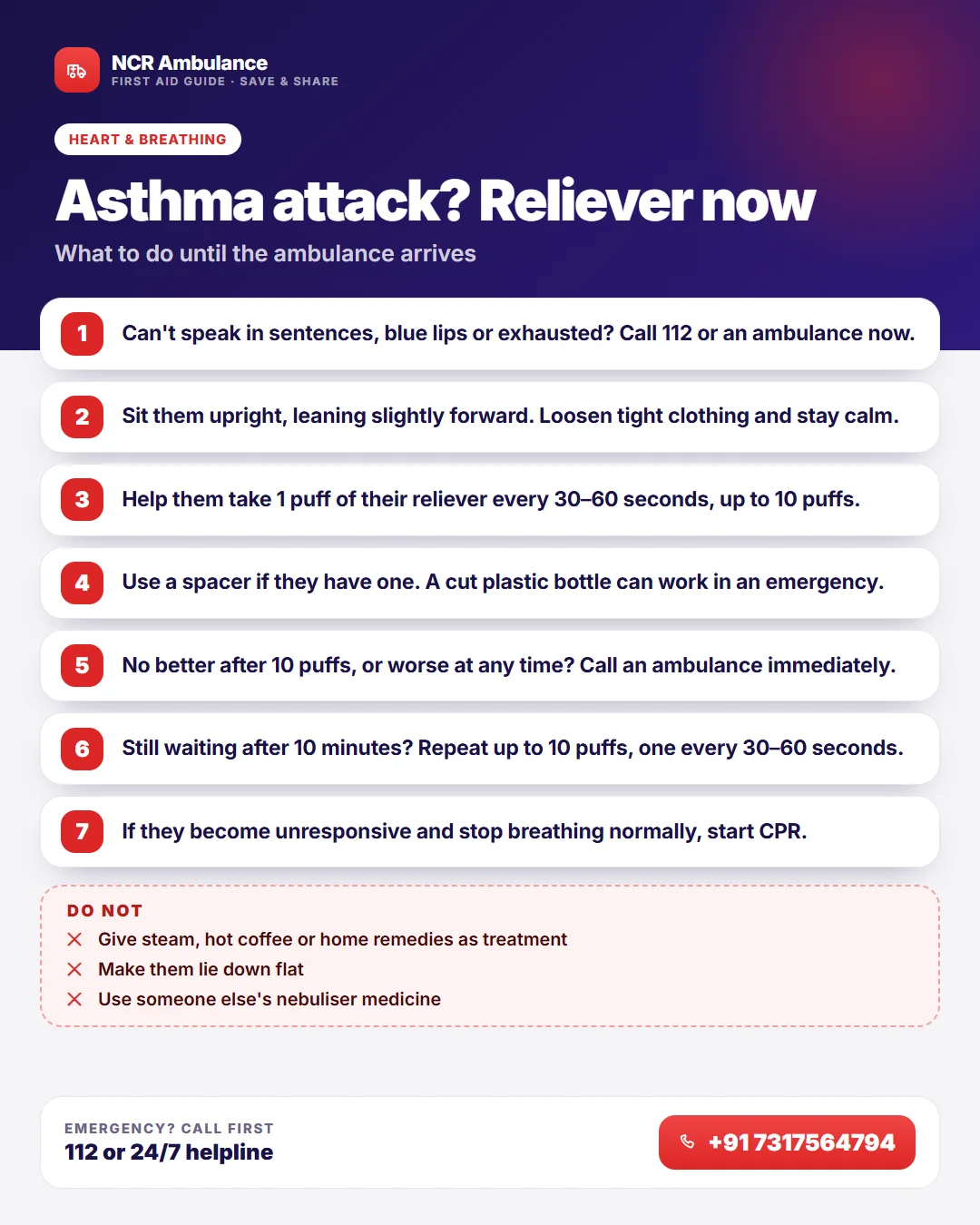
Asthma attack? Reliever now
- Can't speak in sentences, blue lips or exhausted? Call 112 or an ambulance now.
- Sit them upright, leaning slightly forward. Loosen tight clothing and stay calm.
- Help them take 1 puff of their reliever every 30–60 seconds, up to 10 puffs.
- Use a spacer if they have one. A cut plastic bottle can work in an emergency.
- No better after 10 puffs, or worse at any time? Call an ambulance immediately.
- Still waiting after 10 minutes? Repeat up to 10 puffs, one every 30–60 seconds.
- If they become unresponsive and stop breathing normally, start CPR.
Do not
- Give steam, hot coffee or home remedies as treatment
- Make them lie down flat
- Use someone else's nebuliser medicine
In this guide
- Signs that an asthma attack is life-threatening
- What position helps breathing?
- What to do during a severe asthma attack: step by step
- How to use an inhaler with a spacer
- What to do if there is no inhaler
- If things get worse: when to start CPR
- Asthma triggers in Delhi NCR
- Severe asthma attack: quick do's and don'ts
- Be ready before the next attack
It is a smoggy November evening in Delhi NCR. Your teenage son comes home from tuition wheezing, his shoulders heaving, and he can only say two or three words before stopping to breathe. His inhaler is in the school bag he left in a friend's car. Or your elderly mother, whose asthma has been worse since Diwali, is sitting on the edge of the bed, too breathless to speak.
A severe asthma attack can become life-threatening within minutes, but the right first aid helps the airways open while help is on the way. This guide explains the danger signs, the right position, how to use an inhaler with a spacer (including a homemade one), and what to do if there is no inhaler at all. In a severe attack, ask for an ALS ambulance with oxygen support and emergency medicines.
Signs that an asthma attack is life-threatening
During an asthma attack, the airways in the lungs tighten, swell and fill with mucus, so air can't get in and out easily. Call 112 or an ambulance immediately if the person has any of these signs:
- Can't speak in full sentences, or is too breathless to eat, walk or talk.
- Blue or grey lips, tongue or fingertips, or very pale, sweaty skin.
- Exhaustion, drowsiness or confusion, as the effort of breathing wears them out.
- The reliever inhaler isn't helping, or they need it again within minutes.
- Skin sucking in between the ribs or at the base of the throat with each breath, or nostrils flaring in a child.
- A "quiet chest": wheezing that becomes softer or stops, while they are still struggling.
Wheezing is the sound of air squeezing through narrowed airways. If the wheeze fades but the person still looks distressed, drowsy or blue, it can mean very little air is moving at all. This is a sign of a life-threatening attack. Call an ambulance immediately.
What position helps breathing?
Sit the person upright, leaning slightly forward, with their hands resting on their knees or on a table in front of them. This position lets the chest and breathing muscles work most easily. Many people instinctively take it.
- Never make them lie down flat. It makes breathing harder.
- Loosen tight collars, ties, belts, saris or anything around the chest and waist.
- Move them away from the trigger: smoke, incense, mosquito coils, dust, perfume or cold air.
- Stay calm and speak slowly. Panic makes the muscles tighten and the breathing faster.
What to do during a severe asthma attack: step by step
Step 1: Sit them up and keep them calm
Get them into the upright, slightly forward position and stay with them. Reassure them that help is coming. If they show any of the danger signs above, call 112 or an ambulance now, before you do anything else, and put the phone on speaker.
Step 2: Help them use their reliever inhaler
The reliever inhaler contains a medicine such as salbutamol or levosalbutamol that relaxes the airway muscles within minutes. In many countries relievers are blue, but in India the colour varies by brand, so check the label. Help the person take 1 puff every 30 to 60 seconds, up to 10 puffs, ideally through a spacer. Shake the inhaler before each puff.
If the person uses one combined inhaler for both prevention and relief, as some doctors now prescribe, follow their written asthma action plan, because the number of extra puffs can differ.
Step 3: Call an ambulance if they don't improve
If they feel worse at any point, or are not better after 10 puffs, call 112 or an ambulance immediately. Say: "Severe asthma attack, can't speak properly, reliever not working," and give the address with a landmark.
Step 4: Repeat the puffs while you wait
If the ambulance hasn't arrived after 10 minutes and they are still struggling, repeat 1 puff every 30 to 60 seconds, up to 10 puffs. A reliever inhaler is safe to use like this in an emergency. A shaky feeling or fast heartbeat is a common side effect and not a reason to stop.
Step 5: Prepare for the ambulance crew
Keep the inhalers, spacer, any written asthma action plan and a list of the person's medicines ready to hand over. Send someone to unlock the gate, call the lift and guide the crew in. Even if the attack settles, the person should be seen by a doctor the same day, because severe attacks can return.
How to use an inhaler with a spacer
A spacer is a plastic tube that fits on the inhaler. It holds the medicine cloud so the person can breathe it in slowly, which gets far more of the medicine into the lungs, especially when they are breathless and panicking.
- Remove the inhaler cap, shake the inhaler and fit it into the end of the spacer.
- Ask the person to breathe out gently, then seal their lips around the spacer mouthpiece. Young children should use a spacer with a face mask fitted snugly over the nose and mouth.
- Press the inhaler once to release one puff into the spacer.
- Let them breathe in and out slowly through the spacer for about four to five breaths, or take one slow deep breath and hold it for up to 10 seconds if they can.
- Remove, shake again and repeat for each puff.
If there is no spacer, a clean, empty 500 ml plastic water or soft-drink bottle can work. Cut a hole in the base just big enough for the inhaler mouthpiece, push the inhaler in so it fits snugly, and have the person breathe through the bottle's open neck. Use it exactly like a normal spacer, one puff at a time. A paper cup with a hole in the bottom can also help. Without any spacer, use the inhaler directly: breathe out, seal the lips around the mouthpiece, press once as they start a slow breath in, then hold the breath.
Some people use a dry-powder inhaler, such as a capsule device, which doesn't work with a spacer. Help them take their doses as their doctor advised and call for help if they aren't improving.
What to do if there is no inhaler
There is no home substitute for a reliever inhaler in a severe attack. If the person doesn't have their inhaler, the most important thing you can do is get an ambulance on the way quickly.
- Call 112 or an ambulance immediately. Don't wait to see if it passes. Tell the dispatcher there is no inhaler.
- Keep them upright, leaning slightly forward, and stay with them.
- Coach slow breathing: in gently through the nose, then out slowly through pursed lips, as if blowing out a candle. Breathe with them and count slowly. This can ease panic and help empty trapped air.
- Remove the trigger and move them to cleaner air. On a smoggy day, stay indoors with windows closed and an air purifier on if you have one.
- Ask the dispatcher before using any medicine that isn't theirs. If a neighbour has a reliever inhaler, mention it and follow the dispatcher's advice.
Steam inhalation, hot coffee or tea, honey and ginger, ajwain potlis, mustard oil or balm rubs on the chest, and breathing into a paper bag do not treat a severe asthma attack. Some can make it worse: steam can irritate the airways and a paper bag reduces the oxygen they breathe. Don't nebulise someone with another person's medicine. Use the reliever, keep them upright and call for help.
If things get worse: when to start CPR
If the person becomes so exhausted that they can't stay awake, or they stop responding, lay them on their back on the floor and check their breathing. If they are unresponsive and not breathing normally, start CPR straight away and keep going until the crew takes over. Breaths are especially important in asthma, because the problem started with oxygen. Follow our guide on how to do CPR on an adult.
A patient with a life-threatening attack may need oxygen, nebulised medicines and sometimes breathing support during the journey. In the most severe cases, doctors may ask for a ventilator ambulance for patients who need breathing support, particularly for a transfer between hospitals.
Asthma triggers in Delhi NCR
Many asthma attacks in the region follow a familiar pattern. Watch for:
- Winter smog from October to January, when crop-stubble smoke, traffic fumes and still, cold air trap pollution close to the ground.
- Diwali and wedding firecrackers, which fill the air with smoke for days.
- Dust from construction, roadworks and summer dust storms.
- Indoor smoke from agarbatti, mosquito coils, cooking fumes and cigarettes.
- Colds and flu, cold air, exercise, pollen and pet hair.
Breathlessness isn't always asthma. Heart problems, a severe allergic reaction or a lung clot can look similar. Our guide to first aid for sudden breathlessness covers the other causes, and if the attack follows a food, medicine or sting with swelling or a rash, see first aid for a severe allergic reaction.
Severe asthma attack: quick do's and don'ts
Do
- Sit them upright, leaning slightly forward
- Give 1 reliever puff every 30 to 60 seconds, up to 10
- Use a spacer, even a homemade bottle spacer
- Call 112 early if they can't speak or their lips turn blue
- Coach slow breathing out through pursed lips
Don't
- Make them lie down flat
- Use steam, coffee or home remedies as treatment
- Make them breathe into a paper bag
- Use someone else's nebuliser medicine
- Wait for a "quiet" wheeze to mean they're better
Be ready before the next attack
If someone in your family has asthma, make sure they always carry their reliever inhaler and a spacer, check the dose counter and expiry date, and ask their doctor for a written asthma action plan. Keep a spare inhaler and spacer at home, as listed in our home first-aid kit checklist, and teach everyone in the house these steps.
Save our helpline now: +91 7317564794. If an asthma attack doesn't ease, call 112 or our emergency ambulance service any time, day or night. We arrange ambulances through our 24/7 ambulance booking helpline for Delhi NCR, including emergency ambulance in Faridabad.
Save it. Share it.
Keep this step-by-step card on your phone
Emergencies rarely give you time to search. Save this card or share it in your family and society WhatsApp groups. One person who knows what to do can save a life.

Frequently asked questions
How many puffs of a reliever inhaler are safe during an asthma attack?
Widely used first-aid guidance is one puff every 30 to 60 seconds, up to 10 puffs, ideally through a spacer. If the ambulance hasn't arrived after 10 minutes and the person is no better, the 10 puffs can be repeated. Shakiness and a fast heartbeat are common side effects and are not dangerous in this situation. If the person has a written asthma action plan, follow it.
Can I use someone else's inhaler in an emergency?
Tell the emergency dispatcher what is available and follow their advice. Never give someone else's tablets, steroid preventer inhalers or nebuliser solutions, because the wrong medicine or dose can cause harm. While you wait for guidance, keep the person sitting upright, keep them calm, coach slow breathing and make sure an ambulance is already on its way.
Does steam or hot coffee help an asthma attack?
No. Steam can irritate the airways and make breathing harder, and hot vapour can scald. Coffee and tea contain caffeine, which has only a weak and slow effect on the airways and is no substitute for a reliever inhaler. Home remedies such as honey, ginger, ajwain or chest rubs don't open the airways in a severe attack. Use the reliever and call for help.
Is a nebuliser better than an inhaler with a spacer?
For most asthma attacks, a reliever inhaler used through a spacer works as well as a nebuliser and is much quicker to use. Don't waste precious minutes setting up a machine if an inhaler and spacer are at hand. If the person has their own nebuliser and prescribed reliever solution, they can use it as their doctor advised, but call for help first if they are severely breathless.
Is it an asthma attack or a severe allergic reaction?
Both can cause wheezing and breathlessness. A severe allergic reaction (anaphylaxis) usually comes on after a food, medicine or insect sting, and may include swelling of the lips, face or tongue, an itchy rash, vomiting or feeling faint. If you suspect anaphylaxis and the person has a prescribed adrenaline auto-injector, use it first, then their reliever inhaler, and call an ambulance immediately.
Should people with asthma wear a mask during Delhi smog?
A well-fitting N95 mask can reduce the amount of fine smoke and dust breathed in outdoors on bad air days. Some people with asthma find a tight mask uncomfortable, so remove it if it makes breathing harder. Masks are only one part of protection: also limit time outdoors when the air quality is poor, keep the reliever inhaler with you and follow your doctor's asthma plan.
Ambulance services for this emergency
24/7 coverage: Ambulance service in DelhiAmbulance service in GurgaonAmbulance service in NoidaAmbulance service in GhaziabadAmbulance service in FaridabadAmbulance service in Greater NoidaAmbulance service in Dwarka
Related first-aid guides
 Medical Emergencies
Sudden Breathlessness First Aid: When Someone Can't Breathe
 Medical Emergencies
Anaphylaxis First Aid: What to Do in a Severe Allergic Reaction
 Heart & Breathing
How to Do CPR: Step-by-Step Hands-Only CPR for Adults
 Be Prepared
Home First-Aid Kit Checklist: What Every Indian Home Needs