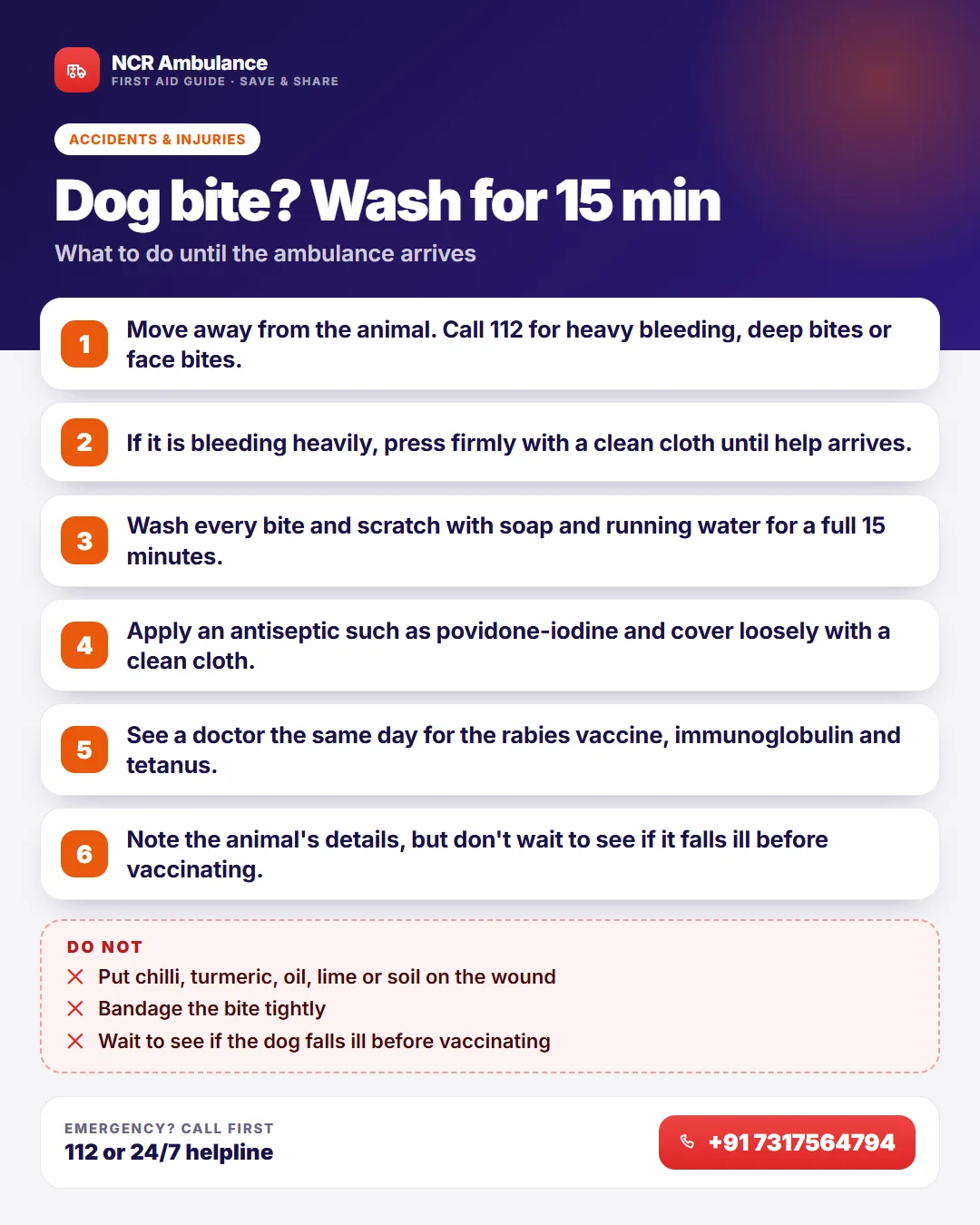
Until the ambulance arrives
Dog bite? Wash for 15 min
- Move away from the animal. Call 112 for heavy bleeding, deep bites or face bites.
- If it is bleeding heavily, press firmly with a clean cloth until help arrives.
- Wash every bite and scratch with soap and running water for a full 15 minutes.
- Apply an antiseptic such as povidone-iodine and cover loosely with a clean cloth.
- See a doctor the same day for the rabies vaccine, immunoglobulin and tetanus.
- Note the animal's details, but don't wait to see if it falls ill before vaccinating.
Do not
- Put chilli, turmeric, oil, lime or soil on the wound
- Bandage the bite tightly
- Wait to see if the dog falls ill before vaccinating
In this guide
- First, get safe and check how serious it is
- Dog bite first aid: step by step
- Rabies exposure categories: which bites need what
- Rabies vaccine and immunoglobulin: how urgent are they?
- Monkey, cat and other animal bites
- Home remedies that make bites worse
- If things get worse
- Dog bite first aid: quick do's and don'ts
It can happen in seconds. A stray dog in your housing society chases a child on a cycle, a neighbour's pet snaps when someone reaches out to pat it, or a monkey on the balcony scratches a hand reaching for the washing. Many families then reach for haldi, chilli powder or mustard oil, tie a bandage on and decide to "watch the dog for a few days". That delay is how rabies happens.
India has one of the highest numbers of rabies deaths in the world, and most of them follow dog bites. Rabies is almost always fatal once symptoms start, but it is preventable with prompt wound washing and timely vaccination. This guide explains what to do in the first 15 minutes, which bites need rabies vaccine and immunoglobulin, and when a bite is serious enough to call an emergency ambulance service.
First, get safe and check how serious it is
Move away from the animal and get the person somewhere safe. Don't chase the dog or try to catch it, because that leads to more bites. Then take a quick look at the wounds.
Call 112 or an ambulance straight away if there is:
- bleeding that is heavy or won't stop with firm pressure
- a bite to the face, head or neck
- several deep bites or torn flesh, for example when a child has been attacked by a pack of stray dogs
- signs of shock: pale, cold, sweaty skin, fast breathing, confusion or drowsiness
- a deep bite to the hand or over a joint, with loss of movement or feeling
Attacks on young children by packs of stray dogs in housing societies and parks have become a known problem in Noida, Gurugram and other parts of the NCR. These injuries can be severe. For a badly injured child, ask for an ALS ambulance with trained medical staff.
Dog bite first aid: step by step
Step 1: Control heavy bleeding first
If the wound is bleeding heavily, press firmly on it with a clean cloth or pad and keep pressing until the bleeding slows or the ambulance crew takes over. If blood soaks through, add another cloth on top rather than lifting the first. Our guide on how to stop severe bleeding explains direct pressure step by step. With severe wounds, leave the washing to the hospital team once bleeding is under control.
Step 2: Wash the wound with soap and running water for 15 minutes
This is the most effective thing you can do at home to prevent rabies. The virus is carried in the animal's saliva, and thorough washing with soap and water removes much of it from the wound before it can take hold.
- Use any soap or detergent and plenty of running water: a tap, or a mug or bottle poured continuously.
- Wash every bite and scratch, including small ones, for a full 15 minutes. Use a timer on your phone, because 15 minutes feels much longer than you expect.
- Let the water run into puncture wounds, and wash gently. Don't scrub hard enough to tear the skin further.
- If saliva got into the eyes, nose or mouth, rinse them well with plenty of clean water.
Step 3: Apply an antiseptic and cover loosely
After washing, apply an antiseptic such as povidone-iodine solution, which is worth keeping in your home first-aid kit. Cover the wound loosely with clean gauze or cloth. Don't bandage it tightly, and don't insist on stitches straight away: doctors often delay or avoid stitching animal bites, because closing them early can trap infection inside.
Step 4: Go to a hospital or anti-rabies clinic the same day
Don't wait until tomorrow or until the weekend is over. Rabies vaccine works best when it is started as early as possible. Government hospitals and many health centres run anti-rabies clinics, and most large private hospitals give the vaccine in their emergency department. The doctor will:
- check and clean the wound again
- decide your exposure category and start the rabies vaccine
- give rabies immunoglobulin into and around the wound if it is a category III exposure
- check whether you need a tetanus injection and, sometimes, antibiotics
Step 5: Note the animal's details, but don't wait on it
If it was a pet, get the owner's name, phone number and the dog's vaccination record. If it was a stray, note where it was so the local municipal body can be informed. Tell the doctor whether the animal seemed ill or behaved strangely. But don't delay vaccination to see whether the animal stays healthy. Watching the dog doesn't replace treatment.
Rabies exposure categories: which bites need what
Doctors use the World Health Organization's three categories of exposure to decide treatment. This table is a guide only; the doctor makes the final decision.
| Category | What happened | What is usually needed |
|---|---|---|
| I | Touching or feeding the animal, or licks on unbroken skin | Wash the area. No vaccine is usually needed. |
| II | Nibbling of uncovered skin, or minor scratches or grazes without bleeding | Wash the wound and start the rabies vaccine straight away. |
| III | Bites or scratches that break the skin and bleed, licks on broken skin, or saliva in the eyes, nose or mouth | Wash the wound, start the vaccine and get rabies immunoglobulin as soon as possible. |
Rabies vaccine and immunoglobulin: how urgent are they?
The rabies vaccine trains the body to make its own antibodies against the virus. Modern vaccines are given in the upper arm, in a few doses over several weeks, on dates the doctor will give you. Complete every dose on time, even if the wound has healed and you feel well. The old course of 14 injections in the stomach is no longer used.
Rabies immunoglobulin (RIG) is ready-made antibody injected into and around the wound. It protects the wound area immediately, during the first days before the vaccine has had time to work. It is needed for category III exposures and should be given as early as possible, ideally with the first vaccine dose. Not every clinic stocks it, so ask, and if needed go to a larger hospital the same day.
There is no safe waiting period with rabies. Symptoms can appear weeks or even months after a bite, and once they do, the disease can't be cured. If you were bitten days or weeks ago and were never vaccinated, see a doctor now: it is still worth starting. If you have had a full rabies vaccine course before, tell the doctor, as you may need fewer doses.
Monkey, cat and other animal bites
Any mammal can carry rabies. In Delhi, monkey bites and scratches are common around homes, offices, temples and parks, and they need exactly the same care as a dog bite: 15 minutes of washing, an antiseptic, and a doctor's assessment for rabies vaccine the same day. The same applies to cats and to wild animals such as jackals and mongooses. Cat bites are small but deep and often become infected, so they may need antibiotics too. Bites from rats and squirrels rarely carry rabies, but clean them well and ask a doctor.
Home remedies that make bites worse
Chilli powder, turmeric, mustard oil, ghee, lime, soil and herbal pastes don't kill the rabies virus. They irritate the wound, raise the risk of infection and, worst of all, give families a false sense of safety that delays vaccination. Washing and the vaccine are what prevent rabies.
There is also no need to avoid particular foods, such as eggs or meat, during the vaccine course, despite what relatives may say. For more household practices that can do harm, read our guide to common first-aid myths in India.
If things get worse
After a severe attack, a person can go into shock from blood loss and pain. If they become pale, cold, sweaty, breathless or drowsy, lay them down, raise their legs if the legs aren't injured, keep them warm and keep pressing on bleeding wounds. If they stop responding and aren't breathing normally, call 112 and start CPR. For a young child, follow our guide to CPR on a child or baby.
In the days after a bite, see a doctor quickly if the wound becomes red, hot, swollen or more painful, oozes pus, or the person develops a fever. These are signs of infection, which is common with cat bites and deep dog bites.
Not every bite needs an emergency ambulance. For a planned hospital visit, for example an elderly person with leg bites who can't walk to an auto, you can book an ambulance online and the team will call you back. For serious bites, call 112 or our emergency ambulance in Faridabad and across the NCR.
Dog bite first aid: quick do's and don'ts
Do
- Wash every bite with soap and running water for 15 minutes
- Apply povidone-iodine and cover loosely
- See a doctor for rabies vaccine the same day
- Complete every dose of the vaccine course
- Call an ambulance for heavy bleeding or face bites
Don't
- Put chilli, turmeric, oil, lime or soil on the wound
- Bandage tightly or insist on immediate stitches
- Wait to see whether the dog falls ill
- Skip the doctor because the bite looks small
- Chase or try to catch the animal
A dog bite isn't something to wait out. Wash it well, protect it, and get to a doctor the same day, every time. Save our 24/7 helpline in your phone, +91 7317564794, and call it or 112 for serious bites. Our 24/7 ambulance service across Delhi NCR can help you reach the right hospital, day or night.
Save it. Share it.
Keep this step-by-step card on your phone
Emergencies rarely give you time to search. Save this card or share it in your family and society WhatsApp groups. One person who knows what to do can save a life.
Frequently asked questions
How soon should I get the rabies vaccine after a dog bite?
As soon as possible, ideally the same day. There is no safe waiting period, because symptoms can appear weeks or months later and rabies can't be cured once they start. Wash the wound for 15 minutes first, then go to a hospital or anti-rabies clinic. If you were bitten some time ago and never got vaccinated, see a doctor now; it is still worth starting.
What is rabies immunoglobulin and who needs it?
Rabies immunoglobulin (RIG) is a ready-made antibody injected into and around the wound. It protects the wound area straight away, in the first days before the vaccine has had time to work. Doctors give it for category III exposures: bites or scratches that break the skin and bleed, licks on broken skin, or saliva in the eyes or mouth. Not every clinic stocks it, so ask.
The dog that bit me is a vaccinated pet. Do I still need injections?
See a doctor anyway and take the dog's vaccination record. A properly vaccinated pet is much less likely to carry rabies, but doses are sometimes missed and records aren't always reliable. Doctors often start the vaccine and may stop the course if the dog stays healthy for 10 days. Let the doctor make that call, and never skip the visit on the owner's word alone.
Do monkey and cat bites also cause rabies?
They can. Any mammal can carry rabies, including monkeys, cats, jackals and mongooses. Monkey bites are common in parts of Delhi and should be treated exactly like a dog bite: wash for 15 minutes, apply an antiseptic and see a doctor the same day. Cat bites are deep and often become infected, so they may also need antibiotics. Rat and squirrel bites rarely carry rabies.
Do I still need 14 injections in the stomach for a dog bite?
No. That was an old type of vaccine that is no longer used. Modern rabies vaccines are given in the upper arm, in a small number of doses spread over a few weeks, and the doctor will give you the dates. Complete every dose, even if the wound has healed and you feel well. You also don't need to avoid any particular foods during the course.
Should I put turmeric or chilli on a dog bite?
No. Turmeric, chilli, oil, lime, soil and herbal pastes don't kill the rabies virus. They irritate the wound, increase the risk of infection and often delay proper treatment. The right first aid is to wash the wound with soap and running water for 15 minutes, apply an antiseptic such as povidone-iodine, cover it loosely, and see a doctor for the rabies vaccine the same day.
Ambulance services for this emergency
24/7 coverage: Ambulance service in DelhiAmbulance service in GurgaonAmbulance service in NoidaAmbulance service in GhaziabadAmbulance service in FaridabadAmbulance service in Greater NoidaAmbulance service in Dwarka