Until the ambulance arrives
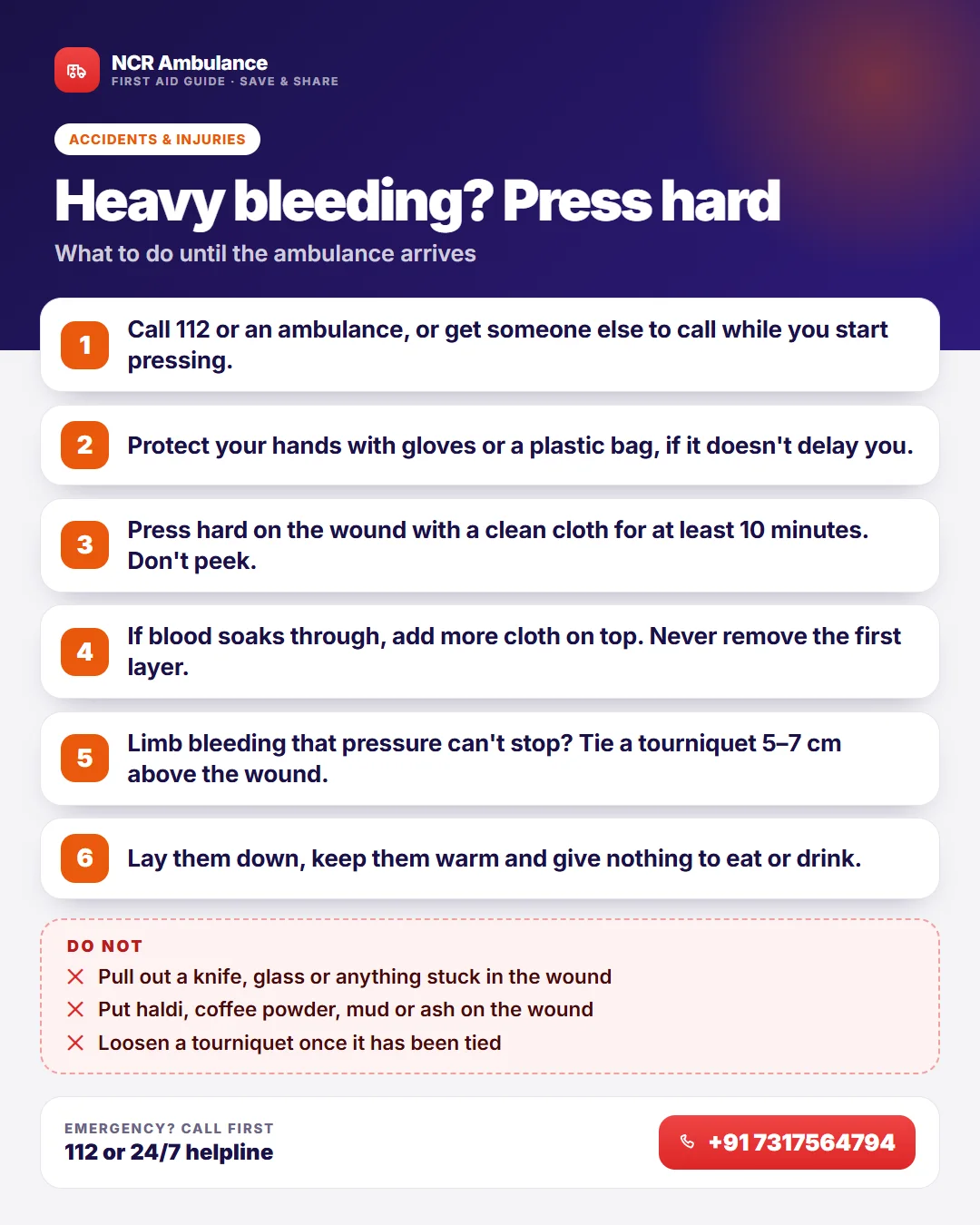
Heavy bleeding? Press hard
- Call 112 or an ambulance, or get someone else to call while you start pressing.
- Protect your hands with gloves or a plastic bag, if it doesn't delay you.
- Press hard on the wound with a clean cloth for at least 10 minutes. Don't peek.
- If blood soaks through, add more cloth on top. Never remove the first layer.
- Limb bleeding that pressure can't stop? Tie a tourniquet 5–7 cm above the wound.
- Lay them down, keep them warm and give nothing to eat or drink.
Do not
- Pull out a knife, glass or anything stuck in the wound
- Put haldi, coffee powder, mud or ash on the wound
- Loosen a tourniquet once it has been tied
In this guide
- How to tell if bleeding is life-threatening
- Protect yourself first
- How to stop severe bleeding: step by step
- When and how to use a tourniquet
- Deep wounds in the groin or armpit: pack and press
- What if something is stuck in the wound?
- Signs of shock from blood loss
- If things get worse: unconscious or not breathing
- Severe bleeding first aid: do's and don'ts
A glass door shatters, a kitchen knife slips, a worker's hand is caught in a machine, or a road crash leaves someone bleeding on the pavement. There is blood everywhere, people are shouting, and someone reaches for haldi or coffee powder. Severe bleeding can kill within minutes, often faster than any ambulance can get through traffic, so the person standing next to the victim is the most important first responder.
This guide shows you how to stop severe bleeding with your own hands while an emergency ambulance is on its way. You'll learn how to apply pressure properly, when and how to use a tourniquet, what to do if something is stuck in the wound, and how to spot shock from blood loss.
How to tell if bleeding is life-threatening
Small cuts stop on their own. Treat bleeding as an emergency and call for help if you see any of these:
- Blood that is spurting or pulsing out of the wound
- Blood that flows steadily and doesn't slow down
- Blood pooling on the ground or quickly soaking through clothes or cloth
- A partly or fully cut-off finger, hand, arm or leg
- A deep wound in the neck, armpit or groin
- The person turning pale, confused or drowsy, which can mean they have already lost a lot of blood
Protect yourself first
Blood can carry infections such as hepatitis B, hepatitis C and HIV. The risk through unbroken skin is low, but put a barrier between your hands and the blood if you can. Use disposable gloves from a first-aid kit, or slip your hands into clean polythene bags. If the injured person is awake and able, ask them to press on their own wound while you get ready.
Don't let this delay you. If nothing is at hand, use a thick folded cloth and wash your hands with soap and water as soon as you can afterwards. A well-stocked home first-aid kit should always include gloves and plenty of gauze.
How to stop severe bleeding: step by step
Step 1: Call for help, or get someone else to call
If you are alone, call 112 or an ambulance helpline such as ours (+91 7317564794), put the phone on speaker and start pressing on the wound while you talk. If others are around, point at one person and tell them to call. They should say "severe bleeding", where on the body it is, and whether the person is awake. For heavy blood loss, ask for an ALS ambulance with oxygen and life-support equipment.
Step 2: Find the wound and press hard with a clean cloth
Expose the wound so you can see where the blood is coming from, cutting or tearing clothing away if needed. Put a clean cloth, gauze pad, folded handkerchief, towel or dupatta directly on it. A clean sanitary pad also works well, because it is very absorbent. Then press down hard with the flat of your palm, using both hands and leaning your body weight over the wound.
Keep pressing for at least 10 minutes by the clock, without lifting to peek. Every time you lift your hands, you can disturb the clot that is starting to form, and the bleeding starts again. Kneel beside the person so you can keep up the pressure without tiring.
Haldi (turmeric), coffee powder, chilli, mud, ash and similar home remedies don't stop serious bleeding. They push dirt and germs deep into the wound, raise the risk of infection and make it much harder for doctors to clean and stitch. Plain, firm pressure with a clean cloth is what works. Read more in our guide to common first-aid myths in India.
Step 3: If blood soaks through, add more on top
If the cloth becomes soaked, don't remove it. Put more cloth on top and press harder. Pulling away the first layer tears away the clot that is forming underneath. If firm pressure still isn't controlling bleeding from an arm or leg, move on to a tourniquet (see below).
Step 4: Raise the limb and bandage the dressing in place
If the wound is on an arm or leg and you don't suspect a broken bone, raising it can help, but only if that doesn't interrupt the pressure. Once the bleeding is under control, tie a strip of cloth or a bandage firmly over the pad to keep the pressure on. Then check the fingers or toes beyond it: if they turn cold, pale, blue or numb, the bandage is too tight, so loosen it slightly.
Step 5: Lay them down and keep them warm
Help the person lie down on a mat, a blanket or the floor. This keeps blood flowing to the brain and stops them fainting and falling. Cover them with a blanket or shawl, keep the pressure on and keep talking to them until the ambulance arrives.
When and how to use a tourniquet
A tourniquet is a tight band around an arm or leg that stops blood reaching the wound. Use one only for life-threatening bleeding from a limb that firm direct pressure hasn't controlled, or when you can't keep pressure on, for example with a cut-off limb or several injured people and only you to help. A tourniquet can't be used on the neck, chest, stomach, armpit or groin.
If your first-aid kit has a ready-made tourniquet, use it according to its instructions. Otherwise, improvise one:
- Place it 5 to 7 cm above the wound, between the wound and the heart. Don't put it over the elbow or knee. If the wound is just below a joint, place it above the joint.
- Use a wide band: a folded dupatta, a triangular bandage, a tie or a strip of cotton cloth, ideally about 4 to 5 cm wide. Wrap it round the limb twice and tie a half knot.
- Add a windlass: lay a short, strong stick, a steel spoon handle or a spanner on the knot and tie a full knot over it. Twist the stick to tighten the band.
- Tighten until the bleeding stops. This will hurt a lot. That is expected, and it means the tourniquet is working.
- Lock the stick in place by tying its ends to the limb with another strip of cloth so it can't unwind.
- Note the time you tied it. Write it on the person's skin with a pen if you can, and tell the ambulance crew.
Once a tourniquet is on, leave it tight until hospital staff take over, however much the person begs you to remove it. Loosening it to "let the blood flow" can restart heavy bleeding. Never use thin wire, string, rope, a rubber band or an electric cable: they cut into the skin and don't press evenly enough to stop the bleeding.
Deep wounds in the groin or armpit: pack and press
A tourniquet can't be used where the limbs join the body. For a deep, gaping wound in the groin or armpit that keeps bleeding, pack the wound. Push clean gauze or cloth firmly into it, right down to where the blood is coming from, and keep feeding more in until it is packed tight. Then press hard on top with both hands for at least 10 minutes, and keep pressing until help arrives.
For a bleeding neck wound, press firmly with a cloth, but never tie a bandage around the neck. Don't pack wounds in the chest or stomach: cover them with a clean cloth, press gently and wait for the ambulance crew.
What if something is stuck in the wound?
If a knife, rod, piece of glass or wood is stuck in the body, don't pull it out. It may be plugging a damaged blood vessel, and removing it can start bleeding you can't control. Leave it for the hospital.
- Press on either side of the object, not on it, to slow the bleeding.
- Build up rolled cloth or bandages around the object so it can't move.
- Bandage over the padding without pressing on the object itself.
- Keep the person still, and don't let anyone cut, bend or wiggle the object.
If a finger or limb has been cut off, wrap the part in clean cloth or cling film, put it in a plastic bag, and place that bag in a second bag or container with ice. Never put the part directly on ice or in water. Send it to hospital with the patient.
Signs of shock from blood loss
When a person loses a lot of blood, inside or outside the body, their organs stop getting enough oxygen. This is called shock, and it can be fatal even after the bleeding seems controlled. Watch for:
- Pale, grey or bluish skin, especially around the lips
- Cold, clammy, sweaty skin
- A fast, weak pulse and fast, shallow breathing
- Thirst, dizziness or nausea
- Restlessness, confusion or drowsiness
Lay them flat, keep them warm with a blanket, loosen tight clothing and keep the pressure on the wound. Give nothing by mouth, not even water, because they may need surgery. Call the dispatcher back to say the person is getting worse.
If things get worse: unconscious or not breathing
If the person stops responding but is still breathing normally, keep up the pressure (or ask a helper to take over). If you don't suspect a neck or back injury, turn them onto their side in the recovery position, and keep checking their breathing.
If they are unresponsive and not breathing normally, start CPR immediately and keep going until help arrives. With two helpers, one keeps pressing on the wound while the other does chest compressions. Our guide to hands-only CPR for adults shows the technique. After a road crash, also follow our road accident first aid steps to keep the scene safe.
Severe bleeding first aid: do's and don'ts
Do
- Call 112 or an ambulance straight away
- Press hard on the wound for at least 10 minutes
- Add more cloth on top if blood soaks through
- Use a tourniquet for limb bleeding you can't control
- Keep the person lying down and warm
Don't
- Lift the cloth to check if the bleeding has stopped
- Pull out an object stuck in the wound
- Use wire, string or a rubber band as a tourniquet
- Loosen a tourniquet once it is on
- Put haldi, coffee powder, chilli, mud or ash on the wound
Most people never expect to face heavy bleeding, but a few minutes of firm pressure is often all it takes to keep someone alive until help reaches them. Save our number now: +91 7317564794. If a patient who has lost a lot of blood must be moved between hospitals, ask for an ICU ambulance with a critical care team. Our helpline arranges ambulances across the region, including ambulance service in Delhi.
Save it. Share it.
Keep this step-by-step card on your phone
Emergencies rarely give you time to search. Save this card or share it in your family and society WhatsApp groups. One person who knows what to do can save a life.
Frequently asked questions
Does haldi (turmeric) stop bleeding from a wound?
Turmeric is a common home remedy for cuts in India, but it won't stop serious bleeding. Putting turmeric, coffee powder, chilli, ash or mud on a wound pushes dirt into it, raises the risk of infection and makes it harder for doctors to clean and stitch. For heavy bleeding, firm pressure with a clean cloth is what works.
How long should I press on a wound to stop bleeding?
Press firmly and continuously for at least 10 minutes, timed by a clock, without lifting your hands to check. Lifting disturbs the clot that is forming, and the bleeding starts again. It can take longer if the person takes blood thinners. If blood soaks through, add more cloth on top and keep pressing until the ambulance crew takes over.
Can a tourniquet make someone lose their arm or leg?
When a tourniquet is used correctly for life-threatening bleeding, the risk to the limb is small compared with the risk of bleeding to death. Serious damage is uncommon when doctors remove it in good time. That is why you should note the time it was tied, never loosen it yourself, and get the person to hospital as quickly as possible.
When does a cut need stitches or a hospital visit?
See a doctor the same day if a cut is deep or gaping, its edges don't come together, it is on the face, hand or over a joint, it was caused by something dirty or rusty or by an animal or human bite, or it is still bleeding after 10 minutes of firm pressure. Ask the doctor whether a tetanus injection is needed.
Is a heavy nosebleed an emergency?
Most nosebleeds stop with simple first aid. Sit the person up, lean them forward and pinch the soft part of the nose firmly for 10 to 15 minutes while they breathe through the mouth. Don't tilt the head back. Call for help if the bleeding hasn't stopped after about 20 minutes, follows a head injury, is very heavy, or the person takes blood thinners.
What if the injured person takes blood thinners?
Medicines such as aspirin, clopidogrel, warfarin and the newer blood thinners make blood slower to clot, so even a moderate cut can bleed heavily. Use the same first aid, but press firmly for longer and call for help sooner. Tell the ambulance crew and the doctors which medicine they take and when the last dose was, because it can change their treatment.
Ambulance services for this emergency
24/7 coverage: Ambulance service in DelhiAmbulance service in GurgaonAmbulance service in NoidaAmbulance service in GhaziabadAmbulance service in FaridabadAmbulance service in Greater NoidaAmbulance service in Dwarka