Until the ambulance arrives
Broken bone? Keep it still
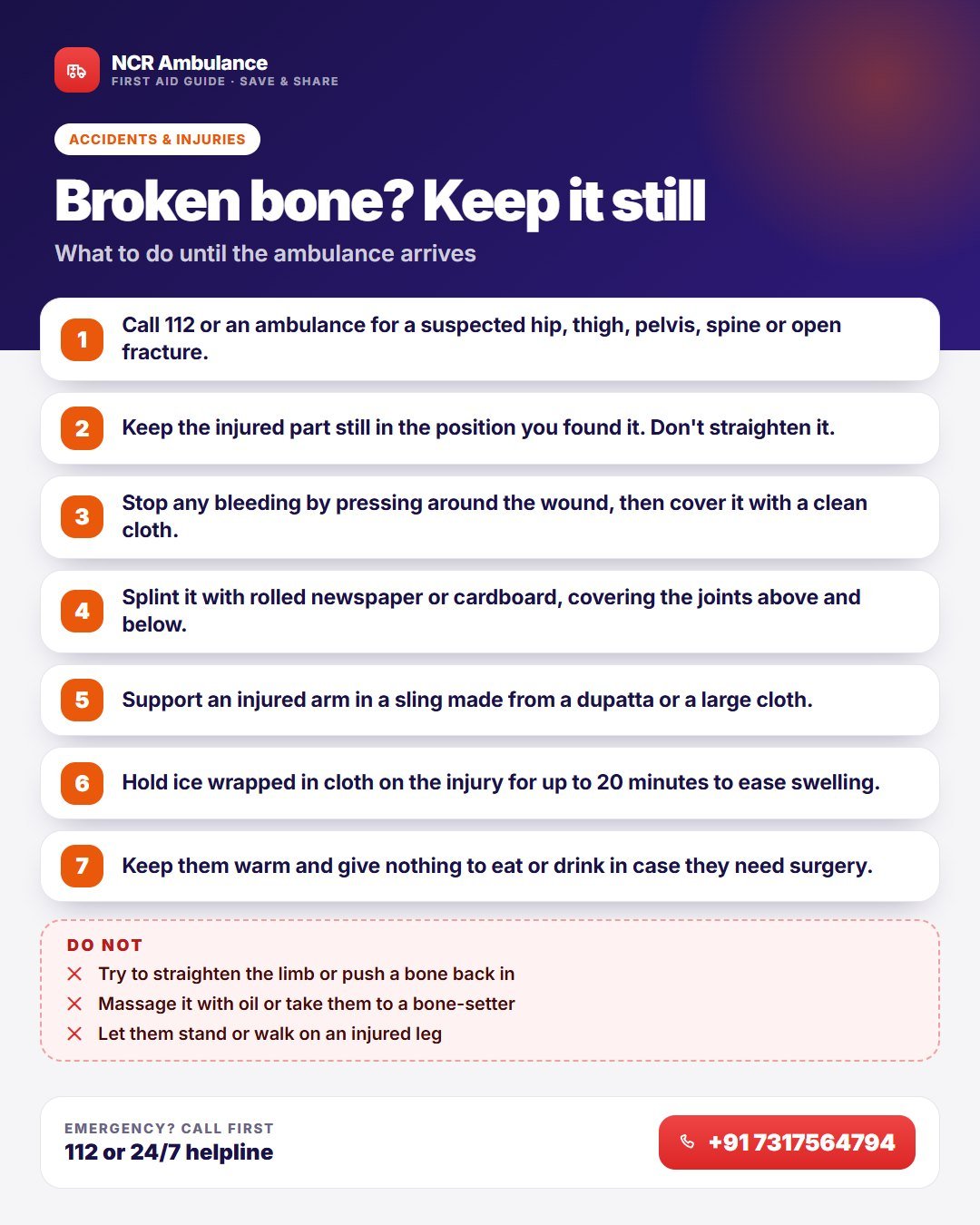
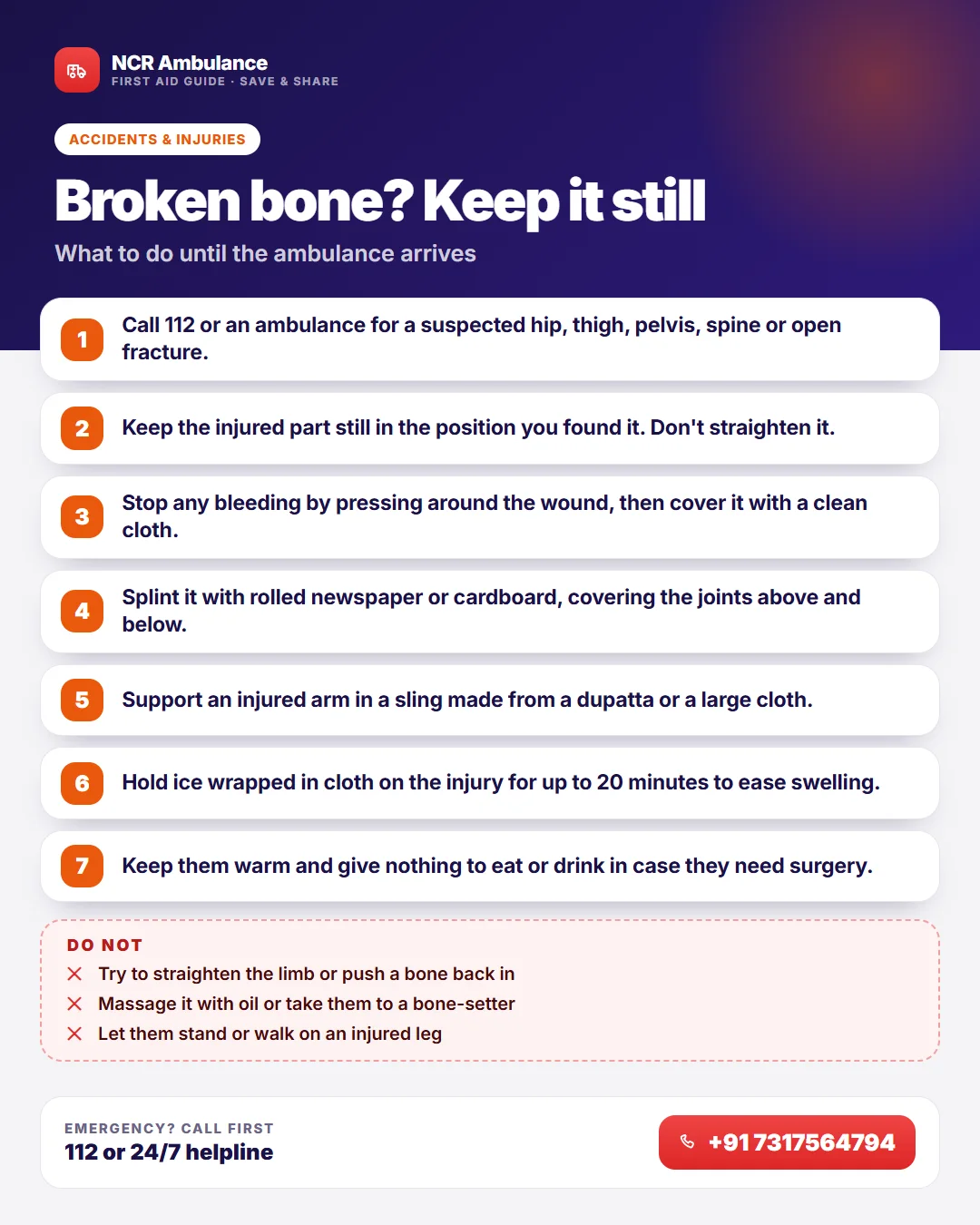
- Call 112 or an ambulance for a suspected hip, thigh, pelvis, spine or open fracture.
- Keep the injured part still in the position you found it. Don't straighten it.
- Stop any bleeding by pressing around the wound, then cover it with a clean cloth.
- Splint it with rolled newspaper or cardboard, covering the joints above and below.
- Support an injured arm in a sling made from a dupatta or a large cloth.
- Hold ice wrapped in cloth on the injury for up to 20 minutes to ease swelling.
- Keep them warm and give nothing to eat or drink in case they need surgery.
Do not
- Try to straighten the limb or push a bone back in
- Massage it with oil or take them to a bone-setter
- Let them stand or walk on an injured leg
In this guide
A child falls off the slide in the society park and won't let anyone touch her wrist. An elderly mother slips in the bathroom and can't get up. A delivery rider skids on a wet road, and his leg looks bent in the wrong place. In moments like these, families often reach for warm mustard oil, try to pull the limb straight, or call the local pehlwan to "set" the bone.
This guide explains how to give first aid for a suspected broken bone until you reach hospital or a BLS ambulance with a stretcher arrives. It covers how to tell a fracture from a sprain, how to make a splint from things you have at home, what to do if the bone is poking through the skin, and why you should never try to straighten it.
Is it a fracture or a sprain?
A fracture is a broken or cracked bone. A sprain is a stretched or torn ligament around a joint, such as the ankle or wrist. They can look alike and only an X-ray can tell for sure, but these signs point towards a fracture:
- A limb that looks bent, twisted or shorter than the other side
- Severe pain at one spot that gets much worse with movement or pressure
- Swelling and bruising that come up quickly
- Being unable to bear weight on it or use it
- A snap or crack heard at the time of injury, or a grating feeling when it moves
- Bone visible through a wound in the skin (an open fracture)
| Fracture | Sprain | |
|---|---|---|
| What is hurt | The bone is broken or cracked | Ligaments around a joint are stretched or torn |
| Shape | May look bent, twisted or shortened | Swollen, but a normal shape |
| Pain | Sharp, at one point on the bone | Around the joint, often less severe |
| Using it | Often can't bear weight or move it | Can usually move it a little, with pain |
| What you do | Splint it, keep it still, go to hospital | Rest, ice and support; see a doctor if it isn't improving |
If you aren't sure, treat it as a fracture. Splinting a sprain does no harm, but walking on a broken bone can.
Fracture first aid: step by step
Step 1: Decide whether you need an ambulance
Don't move the person, and call 112 or an ambulance helpline such as ours (+91 7317564794), if:
- you suspect a broken hip, thigh, pelvis, neck or back
- the bone is through the skin, or there is heavy bleeding
- the hand or foot beyond the injury is cold, pale, blue or numb
- the person has other serious injuries, such as a head injury, or shows signs of shock
- the pain is too severe to move them
For a suspected broken finger, wrist or forearm in someone who is otherwise well, you can usually splint it and take them to hospital by car or taxi, with someone else driving. For anything more serious, ask for an emergency ambulance for injuries and falls.
Step 2: Keep it still in the position you found it
Movement causes pain, and the broken ends can damage nearby nerves, muscles and blood vessels. Ask the person to stay still, and support the injured part with your hands, a pillow or rolled clothes in the position you found it. Don't try to straighten it.
Step 3: Make a splint from things at home
A splint is anything stiff that stops the broken bone moving. The key rule: it must be long enough to include the joint above and the joint below the break. For a broken forearm, that means from the elbow to the wrist and hand.
- Stiff support: a tightly rolled newspaper or magazine, a flattened cardboard box, a wooden scale, a plank or a strong stick.
- Padding: a folded towel, sari, dupatta or clothes between the splint and the skin, especially around the bony parts.
- Ties: strips of cloth, a dupatta, a belt or a crepe bandage, tied above and below the break, never directly over it.
Tie it firmly but not tightly. Check the fingers or toes every few minutes, and loosen the ties if they become cold, pale, blue, tingly or numb. For a suspected broken leg, if an ambulance is on its way and the person is lying still, you don't need to splint it: just support it on both sides with rolled blankets and wait.
Step 4: Support an arm with a sling
For a broken arm, wrist or collarbone, a sling takes the weight off the injury. Fold a dupatta or a large square of cloth into a triangle and place it under the arm with the elbow bent at a right angle. Tie the ends at the side of the neck so the hand rests slightly higher than the elbow. If the elbow can't bend without pain, don't force it: support the arm in the position you found it.
Step 5: Ease swelling with ice wrapped in cloth
Wrap ice or a cold pack (a packet of frozen peas works well) in a thin cloth and hold it gently on the injury for up to 20 minutes. Never put ice directly on the skin, and don't use it over an open wound. Don't apply heat.
Step 6: Keep them warm, calm and fasting
Keep the person lying or sitting comfortably, and cover them to keep them warm. Give nothing to eat or drink, because a broken bone may need setting under anaesthesia or surgery. Ask the doctor or dispatcher before giving any painkiller.
Open fracture: what to do if the bone is visible
When a broken bone pierces the skin, there is a high risk of bleeding and serious infection. It always needs an ambulance and surgery.
- Don't touch the bone or try to push it back in.
- Control bleeding by pressing firmly around the wound, not on the bone end. A ring of rolled cloth around the bone lets you bandage without pressing on it.
- Cover the wound with a clean, non-fluffy cloth or a sterile dressing.
- Keep the limb still and support it as you would any fracture.
Our guide on how to stop severe bleeding explains pressure and padding in more detail.
Should you try to straighten a broken limb?
No. Pulling a limb straight is extremely painful. It can tear the nerves and blood vessels that run beside the bone, and it can push a sharp bone end through the skin, turning a closed fracture into an open one. Doctors realign bones only after an X-ray, with proper pain relief.
The one warning sign to act on quickly is a hand or foot beyond the injury that turns cold, pale or blue, or loses feeling. It can mean the blood supply is being cut off. Don't try to fix it yourself: call the dispatcher immediately and tell them.
Traditional bone-setters and oil massage are still common in many parts of India. But rubbing or pulling a broken bone can shift the broken ends, damage nerves and blood vessels and make the bone heal crooked, and tight traditional bandages can cut off the blood supply to the limb. Get an X-ray and a doctor's treatment instead. See more first-aid myths that do more harm than good.
Hip, thigh, pelvis and spine fractures: don't move them
These are the fractures where moving the person can do the most harm. A broken thigh bone or pelvis can bleed heavily inside the body, and a broken spine can damage the spinal cord. Older people who fall at home often break a hip: they usually can't stand, they have pain in the groin or hip, and the leg may look shorter and turned outwards.
Don't try to lift them, help them stand or carry them down the stairs. Make them comfortable where they are with pillows or rolled blankets around (not under) the injured area, keep them warm and call an ambulance. Our guides on what to do when an elderly person falls and spinal injury first aid cover these situations in detail.
If things get worse: shock or unconsciousness
Large fractures, especially of the thigh or pelvis, can cause shock from blood loss. Watch for pale, cold, clammy skin, a fast weak pulse, fast breathing, confusion or drowsiness. Lay the person flat, keep them warm, give nothing by mouth and call the dispatcher again to say they are getting worse.
If they become unresponsive but are breathing normally, turn them onto their side in the recovery position, unless you suspect a neck or back injury. In that case, keep the head still and only log-roll them if they vomit. If they stop breathing normally, start CPR straight away using our hands-only CPR guide, and continue until help arrives.
Fracture first aid: do's and don'ts
Do
- Keep the injured part still in the position you found it
- Splint past the joints above and below the break
- Pad the splint and check the fingers or toes often
- Cover an open fracture with a clean cloth
- Call an ambulance for leg, hip, pelvis and spine injuries
Don't
- Try to straighten the limb or push a bone back in
- Massage it or rub oil, ghee or haldi paste on it
- Tie bandages tightly over the break
- Put ice directly on the skin or apply heat
- Let them walk on an injured leg or hip
Most fractures heal well with proper treatment, and good first aid in the first hour makes that more likely. Save our number now: +91 7317564794. After treatment, a patient transport ambulance for follow-up visits can take people in plaster, or recovering from hip surgery, to and from hospital lying down. Our helpline arranges ambulances across the region, including ambulance service in Ghaziabad.
Save it. Share it.
Keep this step-by-step card on your phone
Emergencies rarely give you time to search. Save this card or share it in your family and society WhatsApp groups. One person who knows what to do can save a life.
Frequently asked questions
How can I tell if a bone is broken or just sprained?
Often you can't be sure without an X-ray. A broken bone is more likely if the limb looks bent or shortened, the pain is sharp at one spot on the bone, swelling comes up fast, the person can't bear weight, or there was a snap at the time. Sprains hurt around a joint and usually allow some movement. If in doubt, splint it and get it checked.
Is it safe to go to a pehlwan or traditional bone-setter?
It is not recommended. A bone-setter can't see the break without an X-ray, and pulling, massaging or rubbing oil on a fracture can shift the bone ends, damage nerves and blood vessels and lead to the bone healing crooked. Tight traditional bandages can cut off the blood supply to the limb. A doctor can confirm the injury and treat it properly.
Can I give a painkiller for a broken bone?
Check with the dispatcher or a doctor first. A person with a suspected fracture of the leg, hip or pelvis, or an open fracture, may need surgery under anaesthesia, so they should have nothing by mouth. Keeping the limb still, supporting it in a comfortable position and holding a wrapped ice pack on it are safe ways to ease the pain while you wait.
Should I take someone with a broken arm to hospital myself?
For a suspected broken finger, wrist or forearm in someone who is otherwise well, it is usually fine to splint it, put the arm in a sling and go by car or taxi, with someone else driving. Call an ambulance for a suspected leg, hip, pelvis or spine fracture, an open fracture, heavy bleeding, or a hand or foot that is cold or blue.
Should I use ice or heat on a fracture?
Use cold, not heat. Wrap ice or a packet of frozen peas in a thin cloth and hold it on the injury for up to 20 minutes to reduce swelling and pain. Never put ice directly on the skin, and don't put it over an open wound. Heat, hot oil and massage increase swelling and can make the injury worse.
What are the signs of a broken hip in an elderly person?
After a fall, an older person with a broken hip usually has pain in the hip or groin, can't stand or put weight on the leg, and the injured leg may look shorter and turned outwards. Sometimes the signs are milder. Don't try to lift them or help them walk. Keep them warm and comfortable where they are and call an ambulance.
Ambulance services for this emergency
24/7 coverage: Ambulance service in DelhiAmbulance service in GurgaonAmbulance service in NoidaAmbulance service in GhaziabadAmbulance service in FaridabadAmbulance service in Greater NoidaAmbulance service in Dwarka
Related first-aid guides
 Accidents & Injuries
Elderly Fall at Home: What to Do Before You Lift Them
 Accidents & Injuries
Spinal Injury First Aid: Keep the Head and Neck Still
 Accidents & Injuries
How to Stop Severe Bleeding: Pressure, Tourniquets and Shock
 Accidents & Injuries
Road Accident First Aid: What to Do Before the Ambulance Arrives