Until the ambulance arrives
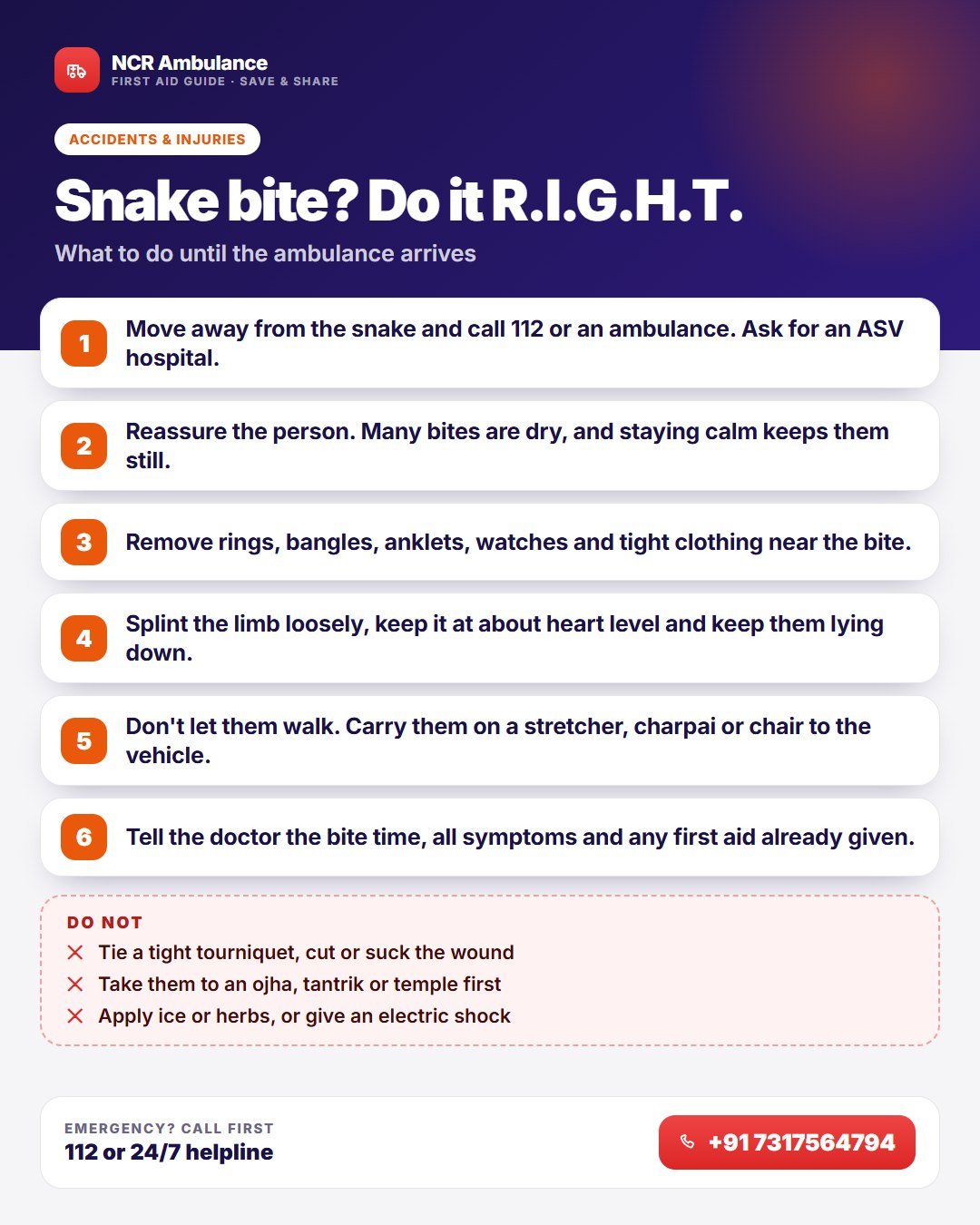
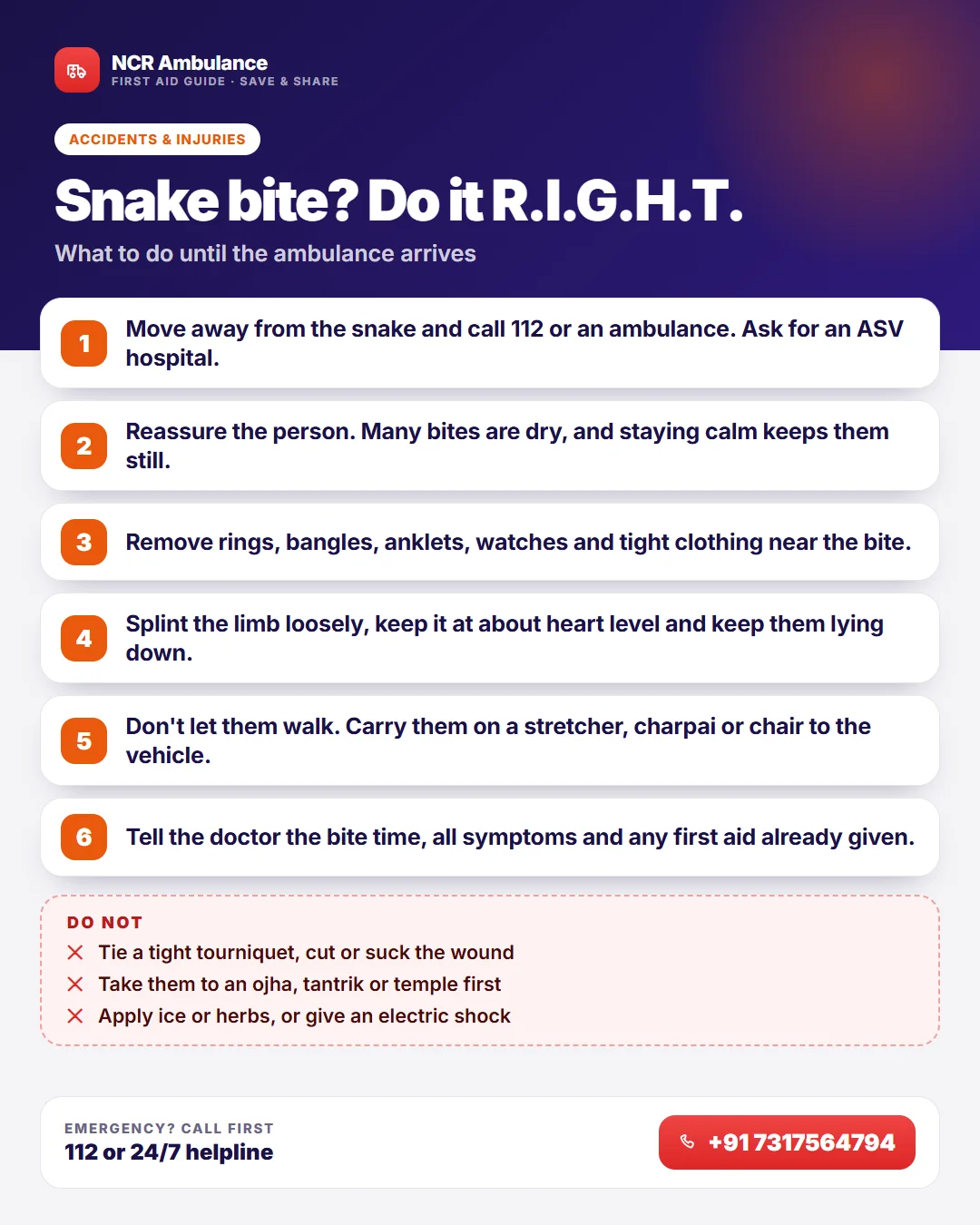
Snake bite? Do it R.I.G.H.T.
- Move away from the snake and call 112 or an ambulance. Ask for an ASV hospital.
- Reassure the person. Many bites are dry, and staying calm keeps them still.
- Remove rings, bangles, anklets, watches and tight clothing near the bite.
- Splint the limb loosely, keep it at about heart level and keep them lying down.
- Don't let them walk. Carry them on a stretcher, charpai or chair to the vehicle.
- Tell the doctor the bite time, all symptoms and any first aid already given.
Do not
- Tie a tight tourniquet, cut or suck the wound
- Take them to an ojha, tantrik or temple first
- Apply ice or herbs, or give an electric shock
In this guide
- Which snakes are dangerous in India?
- Signs of a venomous snake bite
- Snake bite first aid: Do it R.I.G.H.T., step by step
- First-aid myths that kill
- Do you need to catch or identify the snake?
- Why the hospital must have anti-snake venom
- If things get worse: breathing problems and CPR
- How to prevent snake bites in Delhi NCR
- Snake bite first aid: quick do's and don'ts
Snake bites around Delhi NCR rise sharply in the monsoon, when rain floods snakes out of their burrows. A farm worker walking through wet grass in a village on the edge of Greater Noida, a child playing on a farmhouse lawn, a labourer clearing rubble at a construction site, or a family sleeping on the floor on a hot night: any of them can be bitten. Too often, the family's first response is to tie a rope tightly above the bite and take the person to a local ojha or temple. By the time they reach a hospital, hours have been lost.
Snake bites are treatable. Anti-snake venom (ASV), given in hospital, neutralises the venom, and people who get it in time usually recover. This guide covers what to do from the moment of the bite until an ALS ambulance with oxygen and life-support equipment takes over, following the "Do it R.I.G.H.T." approach used in India's snakebite treatment guidelines, along with the myths that waste precious time.
Which snakes are dangerous in India?
Most snakes in India are not venomous, and even venomous snakes sometimes bite without injecting venom, which is called a "dry bite". But most serious bites and deaths are caused by four species, known as the Big Four:
| Snake | What its venom mainly affects | Typical signs |
|---|---|---|
| Spectacled cobra (naag) | Nerves and muscles | Pain and swelling at the bite, drooping eyelids, difficulty swallowing and breathing |
| Common krait | Nerves and muscles | Often painless with tiny marks; hours later stomach pain, drooping eyelids, slurred speech, weakness |
| Russell's viper | Blood clotting and kidneys | Severe pain and swelling, bleeding from the gums or bite, dark or bloody urine |
| Saw-scaled viper | Blood clotting | Pain and swelling, bleeding from the bite, gums or nose |
You can't reliably tell a venomous snake from a harmless one by looking at it, and you don't need to. Treat every snake bite as dangerous until a doctor says otherwise.
Signs of a venomous snake bite
Symptoms can start within minutes or be delayed for several hours, so a person who "seems fine" after a bite still needs a hospital. Watch for:
- one or two puncture marks, though there may be none at all
- pain, swelling or bruising that spreads up the limb
- bleeding from the bite, gums or nose, or red or dark urine
- vomiting, stomach pain, sweating or feeling faint
- drooping eyelids, blurred or double vision, difficulty swallowing, slurred speech
- weakness, difficulty holding the head up, or difficulty breathing
Kraits are active at night and often enter homes. They bite people sleeping on the floor, sometimes when the sleeper rolls onto them. The bite can be painless and leave almost no marks, so the person may go back to sleep. Hours later they wake with stomach pain, drooping eyelids, slurred speech or weakness, and their breathing can fail. If someone wakes at night with an unexplained bite, sudden stomach pain or these signs, especially in the monsoon, treat it as a snake bite emergency and get them to hospital immediately.
Snake bite first aid: Do it R.I.G.H.T., step by step
The R.I.G.H.T. approach is easy to remember in a panic: Reassure, Immobilise, Get to Hospital, Tell the doctor.
Step 1: Move away from the snake and call for help
Get the person, and everyone else, a safe distance away from the snake to avoid a second bite. Call 112 or our 24/7 helpline (+91 7317564794) straight away. Tell the dispatcher it is a snake bite and ask to be taken to a hospital that has anti-snake venom and can manage snake bites. In rural areas, call the hospital ahead if you can.
Step 2: Reassure (R)
Fear makes the heart race and makes people move about, and movement helps venom spread. Speak calmly. Tell them that many bites are dry or from harmless snakes, and that effective treatment is waiting at the hospital. Keep the crowd back and stay with them.
Step 3: Remove anything tight
Gently remove rings, bangles, anklets, toe rings, watches, shoes and tight clothing near the bite. The limb may swell quickly, and anything tight can then cut off the blood supply like a tourniquet. If a bangle won't come off easily, don't force it, but tell the doctor.
Step 4: Immobilise the limb like a fracture (I)
Moving the bitten limb helps venom travel through the body. Keep it as still as possible:
- Splint the limb with a stick, a piece of cardboard, a rolled newspaper or a folded magazine, tied loosely with strips of cloth. You should be able to slide a finger under every tie. Our guide on how to make a splint at home shows the method.
- Keep the bitten limb at about the level of the heart, not raised high or hanging down.
- Keep the person lying down and still. If they vomit or become drowsy, turn them onto their side.
- Don't let them walk, even to the car or the main road. Carry them on a stretcher, a charpai, a door or a chair.
Step 5: Get to Hospital immediately (G, H)
Only anti-snake venom can neutralise the venom, and it works best when given early. Go to a hospital that stocks ASV and can watch the patient closely, usually a district hospital, a medical college or a large hospital, rather than a small clinic. Don't stop at a chemist, a local healer or a temple on the way. If an ambulance will take a long time to reach a remote area, follow the dispatcher's advice on the quickest safe way to travel, with the patient lying down and the limb kept still.
Don't give aspirin or painkillers such as ibuprofen, because some venoms cause bleeding and these medicines can make it worse. Paracetamol is the safer choice if pain relief is needed. Don't give alcohol.
Step 6: Tell the doctor everything (T)
When you arrive, tell the doctor:
- the time of the bite and what the person was doing
- what the snake looked like, if anyone saw it clearly, or show a photo taken safely
- every symptom and when it started, such as vomiting, drooping eyelids or bleeding
- any first aid or traditional treatment already given, including a tourniquet or cuts
First-aid myths that kill
Every one of these is still common in India. None of them removes venom, and each one wastes time or causes new injuries:
- A tight tourniquet: a rope, string or cloth tied tightly above the bite cuts off the blood supply. It can cause gangrene and loss of the limb, and it doesn't reliably stop venom. If one has already been tied, don't rip it off; leave it for the hospital, where doctors can release it with treatment ready.
- Cutting or burning the bite: causes bleeding, infection and damage to nerves and tendons. It is especially dangerous because some venoms stop the blood from clotting.
- Sucking out the venom, by mouth or with a device: it doesn't work and puts the helper at risk.
- Ice, electric shocks, chemicals and herbal pastes: no benefit, and they damage the skin and tissue.
- "Snake stones", mantras, jhaad-phoonk, or a visit to an ojha, tantrik or temple: people who survive after these usually had a dry bite or a bite from a harmless snake. For someone with a real venomous bite, the delay can be fatal.
Families mean well when they turn to these remedies. If you want to help change this in your village or community, share our guide to dangerous first-aid myths in India.
Do you need to catch or identify the snake?
No. Trying to catch or kill the snake leads to more bites and wastes time. Doctors in India decide treatment from the patient's symptoms and simple bedside tests, such as checking whether the blood clots normally, and the anti-snake venom used in India is made to work against all of the Big Four. If someone can take a photo from a safe distance without delay, it may help, but it isn't essential. Never pick up a snake that looks dead: it can still bite by reflex.
Why the hospital must have anti-snake venom
ASV is the only treatment that neutralises snake venom. It is given in hospital under close observation, because some people react to it and the number of doses depends on how the patient responds. The hospital also needs to be ready for complications. Bites that affect the nerves can paralyse the breathing muscles, so the patient may need a ventilator for a time. Viper bites can cause severe bleeding and kidney damage that may need blood products or dialysis.
This is why the first hours matter so much, the same idea behind the golden hour in emergency care. If the patient has any breathing difficulty, tell the dispatcher so they can send a ventilator ambulance for breathing support if one is needed.
If things get worse: breathing problems and CPR
Cobra and krait bites can weaken the muscles used for breathing. Watch for breathing that becomes shallow, noisy or difficult, a weak voice, or trouble swallowing saliva. Turn the person onto their side so saliva and vomit can drain, and update the dispatcher at once.
If they stop responding and aren't breathing normally, start CPR immediately. Because the problem is often paralysis of the breathing muscles, rescue breaths are especially valuable if you are trained to give them. Our step-by-step CPR guide explains how. Keep talking to the patient too: someone paralysed by venom may not be able to move or open their eyes but can sometimes still hear you.
How to prevent snake bites in Delhi NCR
- Wear closed shoes and long trousers in fields, gardens, parks and construction sites, especially after rain.
- Carry a torch when walking outside at night.
- Sleep on a cot or bed rather than the floor, with a mosquito net tucked in under the mattress.
- Keep grass short, and keep rubble, firewood and stacked bricks away from the house.
- Don't put your hands into holes, under stones or into piles of hay or wood.
- If you see a snake, back away slowly and call a trained snake rescuer or the forest department rather than trying to kill it.
If you live or work near fields, farmhouses or construction sites on the edges of the city, save the number for an emergency ambulance in Greater Noida and find out which nearby hospital stocks anti-snake venom before the monsoon begins.
Snake bite first aid: quick do's and don'ts
Do
- Move away from the snake and call for help
- Keep the person calm, lying down and still
- Remove rings, bangles and tight clothing
- Splint the limb loosely at about heart level
- Go straight to a hospital with anti-snake venom
Don't
- Tie a tight tourniquet or rope above the bite
- Cut, suck, burn or put ice on the wound
- Waste time with an ojha, tantrik or jhaad-phoonk
- Let the person walk or run for help
- Try to catch or kill the snake
A snake bite is frightening, but the right steps are simple: keep calm, keep still, and get to anti-snake venom fast. Save our 24/7 helpline, +91 7317564794, before the monsoon season, and call our emergency ambulance service or 112 the moment someone is bitten.
Save it. Share it.
Keep this step-by-step card on your phone
Emergencies rarely give you time to search. Save this card or share it in your family and society WhatsApp groups. One person who knows what to do can save a life.
Frequently asked questions
Which snakes are most dangerous in India?
Most serious bites in India come from the Big Four: the spectacled cobra, the common krait, Russell's viper and the saw-scaled viper. Cobras and kraits mainly affect the nerves and can paralyse breathing, while the two vipers mainly cause bleeding, swelling and kidney damage. Many other snakes, such as the common rat snake, are harmless, but you can't tell reliably by looking, so treat every bite as dangerous.
Should I tie a cloth or rope above a snake bite?
No. A tight tourniquet doesn't reliably stop venom and can cut off the blood supply, causing gangrene and even loss of the limb. Instead, remove tight items, splint the limb loosely and keep the person still. If a tourniquet has already been tied, don't rip it off on the way. Tell the hospital doctor, who will remove it safely with treatment ready.
Do I need to bring the snake to the hospital?
No. Doctors decide treatment from the patient's symptoms and simple blood tests, and the anti-snake venom used in India is made to cover all of the Big Four. Chasing or killing the snake often leads to more bites. A photo taken from a safe distance can help, but only if it causes no delay. Never handle a snake that looks dead, because it can still bite.
Can an ojha or jhaad-phoonk cure a snake bite?
No. Only anti-snake venom given in a hospital can neutralise venom. People who recover after visiting a healer usually had a dry bite or a bite from a non-venomous snake, which is why the belief continues. For someone with a real venomous bite, the hours lost can be fatal. Go straight to a hospital that has anti-snake venom. Prayers can be said on the way.
What does a krait bite feel like?
Often it feels like nothing at all. Kraits usually bite at night, often people sleeping on the floor, and the bite may be painless with tiny or no marks. Hours later the person may develop stomach pain, drooping eyelids, double vision, slurred speech, weakness and difficulty breathing. If anyone wakes at night with these symptoms, especially in the monsoon, treat it as a snake bite and go to hospital.
Where can I get anti-snake venom in Delhi NCR?
Anti-snake venom is usually stocked by government district hospitals, medical colleges and many larger private hospitals, but availability can vary. When you call 112 or an ambulance helpline, say it is a snake bite and ask to be taken to a hospital that has anti-snake venom and can provide intensive care if needed. Don't lose time at small clinics that may not stock it.
Ambulance services for this emergency
24/7 coverage: Ambulance service in DelhiAmbulance service in GurgaonAmbulance service in NoidaAmbulance service in GhaziabadAmbulance service in FaridabadAmbulance service in Greater NoidaAmbulance service in Dwarka