Until the ambulance arrives
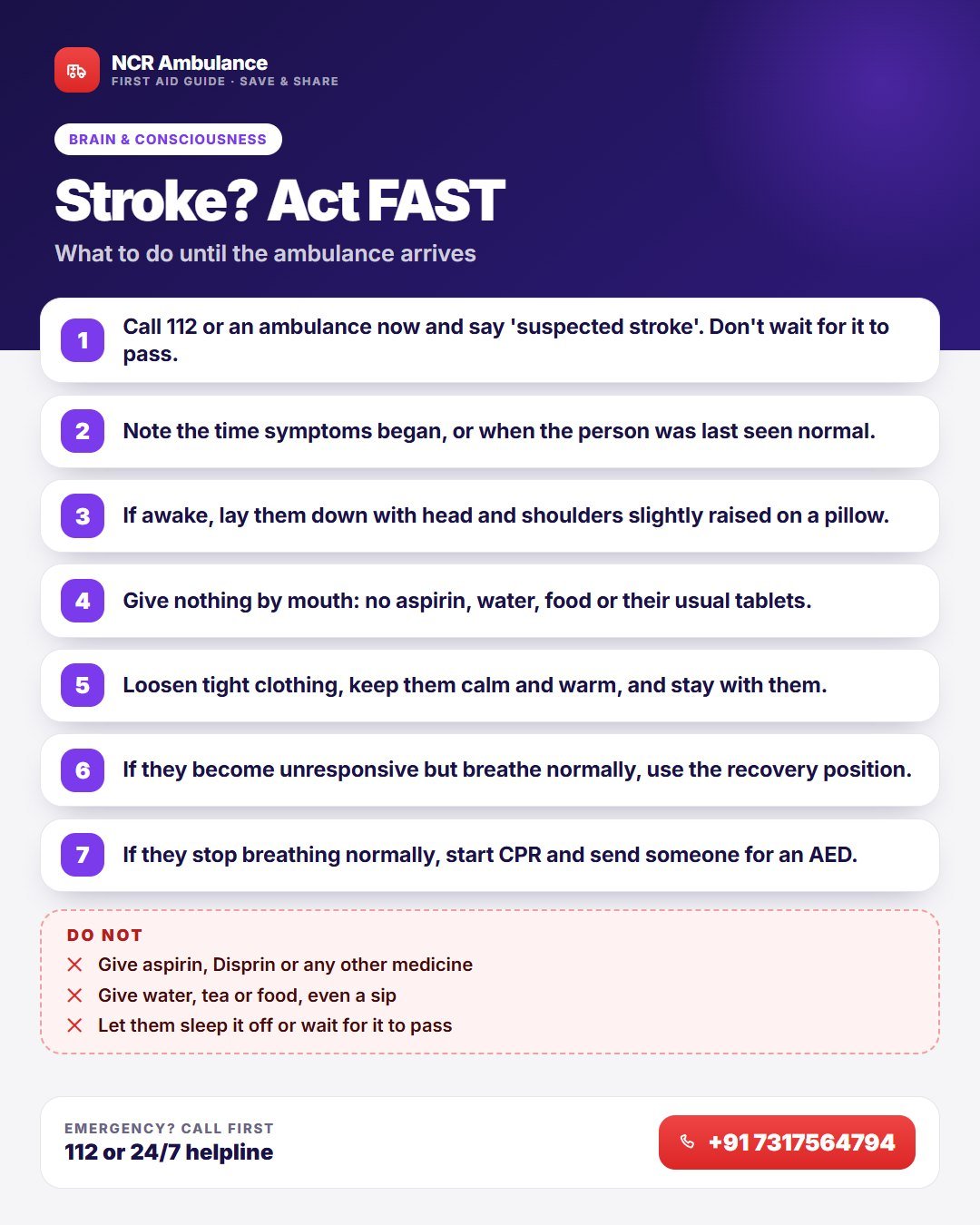
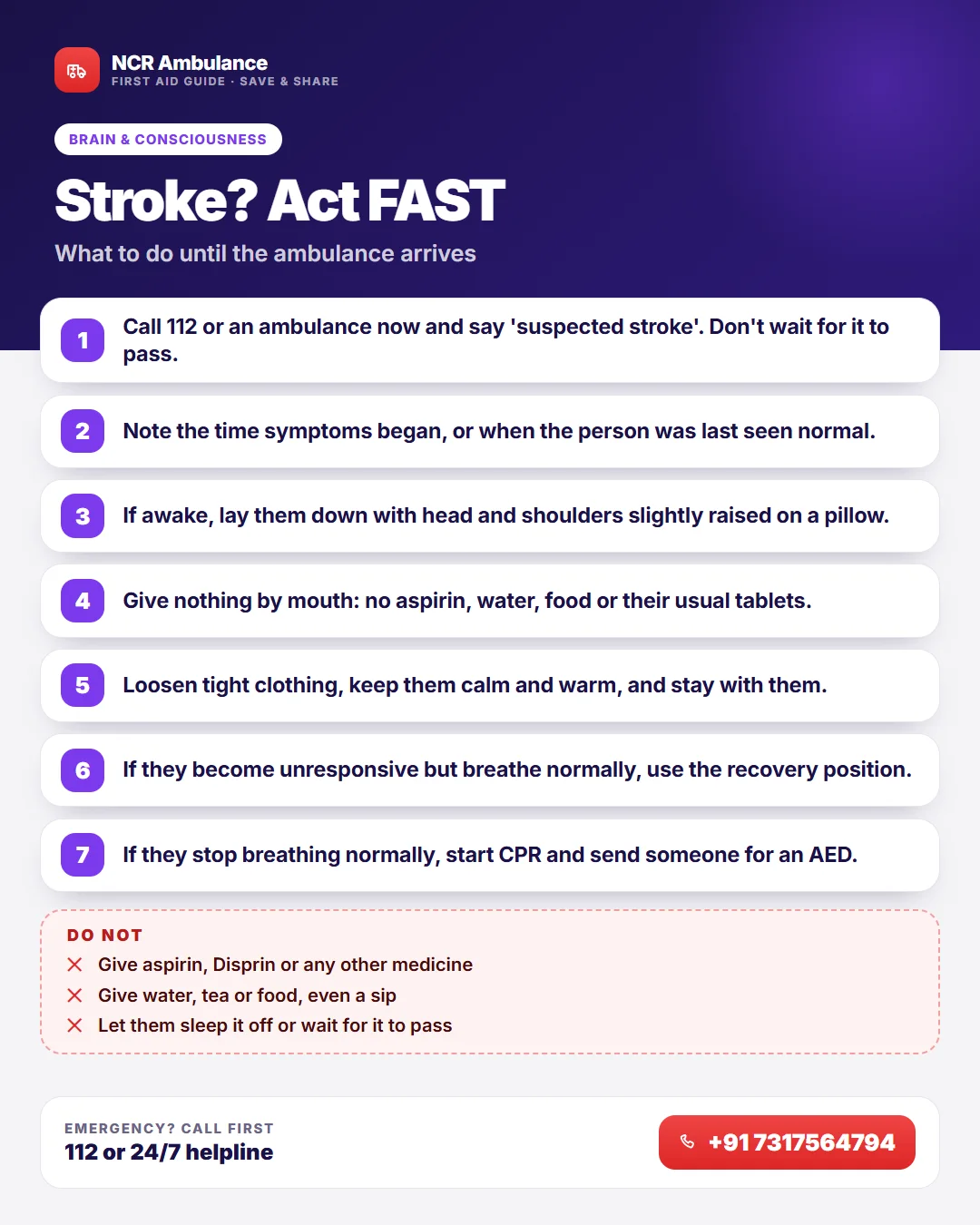
Stroke? Act FAST
- Call 112 or an ambulance now and say 'suspected stroke'. Don't wait for it to pass.
- Note the time symptoms began, or when the person was last seen normal.
- If awake, lay them down with head and shoulders slightly raised on a pillow.
- Give nothing by mouth: no aspirin, water, food or their usual tablets.
- Loosen tight clothing, keep them calm and warm, and stay with them.
- If they become unresponsive but breathe normally, use the recovery position.
- If they stop breathing normally, start CPR and send someone for an AED.
Do not
- Give aspirin, Disprin or any other medicine
- Give water, tea or food, even a sip
- Let them sleep it off or wait for it to pass
In this guide
- What is a stroke?
- The BE FAST signs of a stroke
- Why every minute matters: the treatment window
- What to do if you suspect a stroke: step by step
- Should you give aspirin, water or food? No, and here's why
- Which hospital is "stroke-ready"?
- If things get worse: unresponsive, vomiting or not breathing
- Heart attack or stroke: why the first aid differs
- Stroke first aid: quick do's and don'ts
It often starts with something small. Your father is reading the newspaper over his morning chai when the cup slips from his hand, or your mother's words come out jumbled during a phone call. Someone says it's tiredness or high BP and suggests they lie down for a while. That pause, while everyone waits for it to pass, is the most costly mistake families make with a stroke.
A stroke is a brain attack, and the treatments that limit the damage only work within a few hours of it starting. This guide shows you how to recognise a stroke using BE FAST, what to do (and not do) in the minutes before help arrives, and why the hospital you choose matters. Save the number of a 24/7 emergency ambulance service in Delhi NCR before you ever need it.
What is a stroke?
A stroke happens when the blood supply to part of the brain is suddenly cut off. In most strokes, a clot blocks an artery in the brain (an ischaemic stroke). In others, a blood vessel bursts and bleeds into the brain (a haemorrhagic stroke). Without a steady flow of blood and oxygen, brain cells begin to die within minutes.
From the outside, a clot and a bleed look exactly the same. Only a CT or MRI scan at a hospital can tell them apart, and that single fact shapes almost everything about stroke first aid.
The BE FAST signs of a stroke
BE FAST is a simple way to remember the most common warning signs. They usually come on suddenly, and often affect one side of the body.
- B for Balance: sudden dizziness, loss of balance or coordination, or trouble walking.
- E for Eyes: sudden blurred or double vision, or loss of sight in one or both eyes.
- F for Face: ask them to smile. Does one side of the face droop or look uneven?
- A for Arm: ask them to raise both arms. Does one arm drift down, or feel weak or numb? The leg on the same side may be weak too.
- S for Speech: is their speech slurred or strange? Can they repeat a simple sentence and understand what you say?
- T for Time: if you see even one of these signs, it's time to call an ambulance. Note the time the symptoms started.
Other sudden signs include a very severe headache unlike any before, confusion, vomiting, and numbness or tingling down one side. A person does not need to have all the signs. One sudden sign is enough to call.
Sometimes the face droop or weak arm lasts only a few minutes and then disappears. This may be a transient ischaemic attack (TIA), often called a mini-stroke. It is a warning that a major stroke may follow, often within days. Treat it as an emergency and get the person to hospital, even if they now say they feel fine.
Why every minute matters: the treatment window
Doctors say "time is brain". During a major stroke, vast numbers of brain cells are lost for every minute the blood supply stays blocked. The earlier treatment starts, the more of the person's speech, movement and independence can be saved.
For a stroke caused by a clot, there are two main hospital treatments:
- Clot-busting medicine (thrombolysis), given through a drip. It works only within a few hours of the stroke starting, commonly up to 4.5 hours, and works best the earlier it's given.
- Clot removal (thrombectomy), where a specialist pulls the clot out through a thin tube passed up from an artery. This can help selected patients with large blockages, sometimes even later than the clot-busting window, depending on their scans.
Both need a brain scan first to rule out bleeding, and that takes time at the hospital too. So the window is not "4.5 hours to reach hospital": it's 4.5 hours for everything, including the journey, the scan and the tests. This is why the golden hour in emergency care applies so strongly to strokes.
The most useful thing you can tell the doctors is the "last known well" time: the last time the person was seen behaving normally. If they woke up with symptoms, it's the time they went to sleep or were last seen normal, not the time they woke up. Write it down or note it on your phone.
What to do if you suspect a stroke: step by step
Step 1: Call an ambulance immediately
Don't wait to see if the symptoms improve, and don't call the family doctor first. Dial 112 or a 24/7 ambulance helpline such as ours (+91 7317564794). Say clearly: "Suspected stroke. Face drooping and slurred speech, started at 9:40 this morning." Give the full address with a landmark and ask for an ALS ambulance with oxygen and monitoring. Our guide on what to tell the ambulance dispatcher has a short script you can follow.
Step 2: Note the time and the symptoms
Write down the last known well time, which signs you noticed and when each one began. If the symptoms change, note that too. Under stress, family members often remember the timeline differently, and a written note avoids confusion at the hospital.
Step 3: Position them safely
- If the person is awake, help them lie down with their head and shoulders slightly raised on a pillow or folded blanket.
- If they're in a chair and leaning or slipping to one side, ease them down to the floor or onto a bed so they can't fall.
- Rest a weak arm on a pillow so it doesn't hang down or get trapped under the body.
- If they become drowsy or unresponsive but are breathing normally, or they are drooling or vomiting, turn them onto their side in the recovery position so the airway stays clear.
- Don't let them walk to the car, the lift or the bathroom. A weak leg can give way without warning.
Step 4: Give nothing by mouth
No aspirin, no water, no tea, no food and no regular tablets until doctors at the hospital say it's safe. The reasons are explained further down. If their mouth feels dry, you can moisten their lips with a damp cloth.
Step 5: Keep them calm, warm and watched
- Loosen tight collars, belts and saris, and cover them with a light blanket if the room is cold.
- Talk to them calmly, even if they can't reply. Many stroke patients understand far more than they can say.
- Keep checking their breathing and whether they respond to you.
- If they have diabetes and you have a glucometer, a quick sugar reading helps the crew, because very low sugar can look like a stroke. Don't put sugar in their mouth unless they are fully alert, can swallow normally and the dispatcher advises it.
Step 6: Get ready for the ambulance crew
While one person stays with the patient, another should unlock the gate, call the lift to the ground floor and tell the society guard. Gather a list of current medicines (especially blood thinners), recent reports and an ID card. Most importantly, the person who saw the symptoms begin should travel with the patient, so they can give the timeline to the doctors.
Should you give aspirin, water or food? No, and here's why
Families want to do something, so they reach for a tablet or a glass of water. In a stroke, both can cause harm.
- Aspirin can make a bleed worse. Aspirin thins the blood. That helps in a heart attack, but in a stroke you can't know whether the cause is a clot or a bleed. If it's a bleed, aspirin may make it bigger. Doctors give it only after a scan.
- Swallowing may not be safe. A stroke often weakens the throat muscles. Water, food or a tablet can slip into the windpipe instead of the food pipe, causing choking or a serious chest infection (aspiration pneumonia).
- An extra BP tablet can backfire. Blood pressure is often high during a stroke, and bringing it down suddenly at home can reduce blood flow to the struggling brain. Doctors control it carefully in hospital.
A viral message claims that pricking the fingertips or earlobes with a needle can "release pressure" and reverse a stroke. It cannot. Neither can putting oil or ghee in the nose, massaging the limbs, or making the person walk "to check". These remedies delay treatment and can cause infection or choking. What helps is reaching a stroke-ready hospital quickly.
Which hospital is "stroke-ready"?
The nearest hospital is not always the right one for a stroke. A small nursing home without a scanner may have to refer the patient onwards, and time is lost on the way. A stroke-ready hospital should have:
- a CT or MRI scanner available 24×7, so the brain can be scanned soon after arrival,
- a neurologist or stroke team on call round the clock,
- the ability to give clot-busting treatment in the emergency department, and
- ideally, facilities for clot removal (thrombectomy) and an ICU or stroke unit.
Find out now which hospitals near your home have these facilities, and keep that list with your emergency numbers. On the day, tell the ambulance crew it's a suspected stroke and when it started. They can advise on the nearest capable centre and, where possible, alert the hospital in advance. Our partner crews cover the whole region, from our ambulance service in Delhi to the ambulance service in Noida.
If the patient first reaches a hospital that can scan but can't remove clots, they may need a quick transfer. A monitored ICU ambulance for critical patients or a planned hospital-to-hospital transfer keeps them safe on the way.
If things get worse: unresponsive, vomiting or not breathing
A stroke can worsen while you wait. Keep watching and act on what you see:
- Vomiting or drooling: turn them onto their side straight away so the airway stays clear.
- Unresponsive but breathing normally: place them in the recovery position and keep checking their breathing. Our guide to first aid for an unconscious person shows how, step by step.
- A fit (seizure): this can happen with a stroke. Clear the space around them, cushion the head and don't hold them down. Turn them on their side once the jerking stops.
- Not breathing normally (no breathing, or only occasional gasps): tell the dispatcher, start hands-only CPR and send someone for an AED.
Heart attack or stroke: why the first aid differs
| Heart attack | Stroke | |
|---|---|---|
| Main signs | Chest pressure or pain, sweating, breathlessness | Face droop, arm weakness, slurred speech, loss of balance or vision |
| Aspirin? | Yes, one to chew, if safe and not allergic | No. It could worsen a bleed |
| Food or water | Avoid | Nothing at all by mouth |
| Position | Half-sitting, knees bent | Lying with head and shoulders slightly raised |
| Hospital needs | 24×7 cath lab | 24×7 CT or MRI and a stroke team |
Stroke first aid: quick do's and don'ts
Do
- Use BE FAST and call at the first sudden sign
- Note the last known well time
- Keep them lying with head and shoulders slightly raised
- Turn them on their side if they vomit or become drowsy
- Choose a hospital with a 24×7 scanner and stroke team
Don't
- Wait for symptoms to settle or let them sleep it off
- Give aspirin, BP tablets or any other medicine
- Give water, tea, food or home remedies
- Let them walk, even to the bathroom
- Ignore symptoms that came and went
You can't dissolve a clot at home. What you can do is spot the signs in seconds, make the call in the first few minutes, keep the person safe and give the doctors an accurate time. That gives the hospital team the best possible chance to limit the damage.
Save our number now: +91 7317564794. If you ever see the signs of a stroke, call 112 or our emergency ambulance helpline straight away, day or night.
Save it. Share it.
Keep this step-by-step card on your phone
Emergencies rarely give you time to search. Save this card or share it in your family and society WhatsApp groups. One person who knows what to do can save a life.
Frequently asked questions
Can I give aspirin to someone having a stroke?
No. Unlike a heart attack, a stroke can be caused either by a clot or by bleeding inside the brain, and only a CT or MRI scan can tell which. If it is a bleed, aspirin can make it worse. Swallowing may also be affected, so even a tablet could cause choking. Leave all medicines to the hospital team, who decide after the scan.
What is the time limit for stroke treatment?
Clot-busting medicine (thrombolysis) can only be given within a few hours of the stroke starting, commonly up to 4.5 hours, and works best the sooner it is given. Clot removal (thrombectomy) can help some patients with large blockages even later, depending on their scan results. Both depend on knowing when symptoms began, and both need time at the hospital for tests, so call an ambulance immediately.
What is a mini-stroke (TIA), and does it need an ambulance?
A transient ischaemic attack, or mini-stroke, causes the same signs as a stroke, such as face droop, arm weakness or slurred speech, but they go away within minutes or hours. It is a serious warning that a full stroke may follow, often within days. Call an ambulance or go to a hospital emergency department right away, even if the person feels completely normal again.
Does pricking the fingers with a needle help during a stroke?
No. This claim keeps circulating on WhatsApp, but there is no medical basis for it. Pricking the fingers or earlobes cannot remove a clot or stop a bleed in the brain, and it wastes minutes that matter. It can also cause infection. The same is true of oil in the nose, massaging the limbs or forcing the person to walk. Call an ambulance instead.
Can young people have a stroke?
Yes. Strokes are more common after middle age and in people with high blood pressure, diabetes, high cholesterol, an irregular heartbeat or a smoking habit, but they can happen at any age, including in people in their twenties and thirties. Young people and their families often dismiss the signs as migraine, stress or tiredness. If the BE FAST signs appear suddenly, treat it as a stroke whatever the age.
Should we take a stroke patient to the nearest hospital?
Not always. The right hospital is the nearest one that can scan the brain round the clock and has a stroke team ready to give clot-busting treatment. A clinic without a scanner may have to send the patient on, losing valuable time. Ask your family doctor now which nearby hospitals have these facilities, and tell the ambulance crew your preference so they can advise.
Ambulance services for this emergency
24/7 coverage: Ambulance service in DelhiAmbulance service in GurgaonAmbulance service in NoidaAmbulance service in GhaziabadAmbulance service in FaridabadAmbulance service in Greater NoidaAmbulance service in Dwarka
Related first-aid guides
 Brain & Consciousness
Unconscious Person First Aid: What to Do if Someone Faints
 Be Prepared
The Golden Hour in Emergencies: Why Every Minute Counts
 Heart & Breathing
Heart Attack First Aid: What to Do Before the Ambulance Arrives
 Heart & Breathing
How to Do CPR: Step-by-Step Hands-Only CPR for Adults